
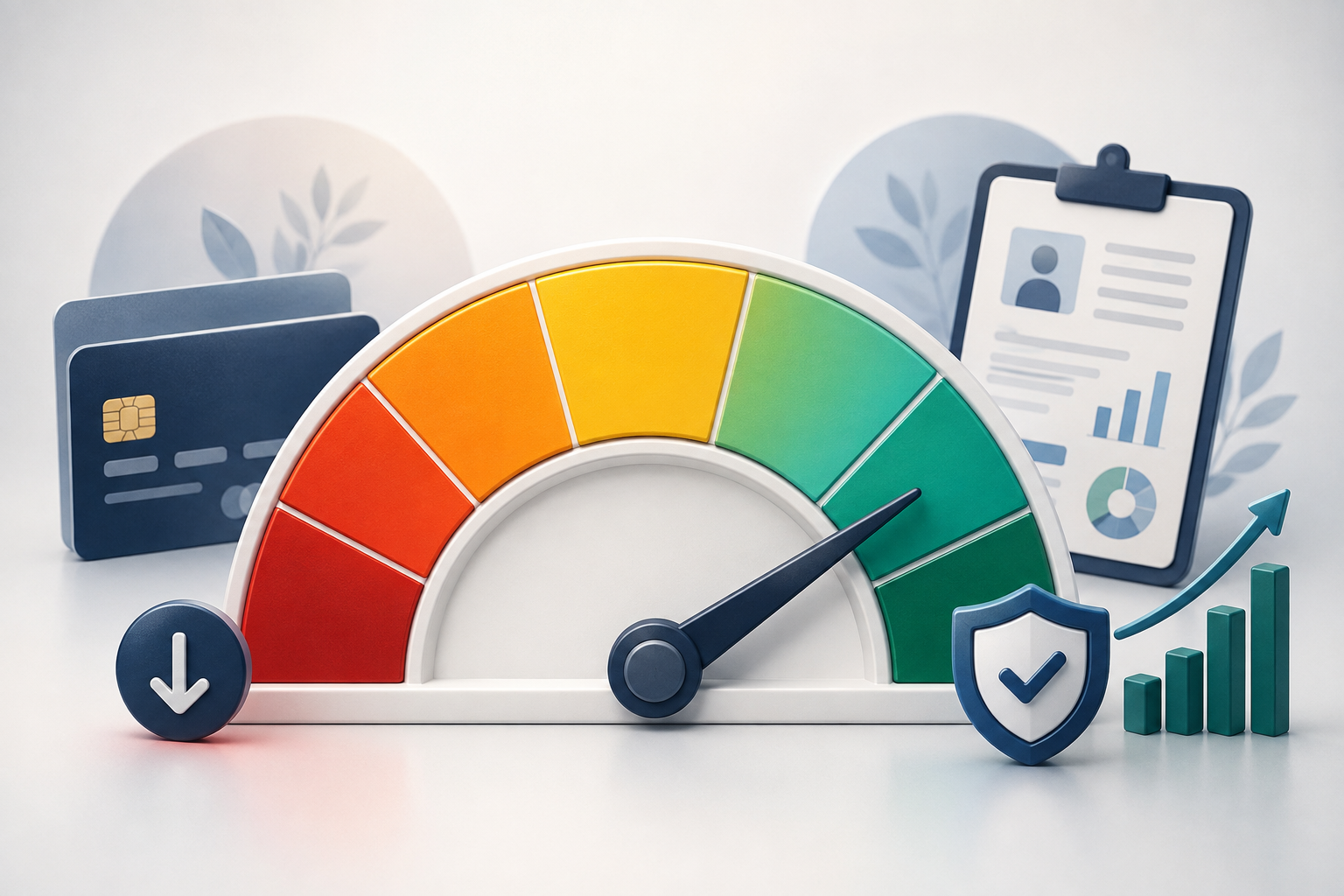
Credit Score Ranges: What Your Score Means
Credit score ranges translate a three-digit score into a broad risk category. Many U.S. consumer scores run from 300 to 850, but the meaning of a number depends on the scoring model, version, credit bureau data, loan type, and lender.
The short answer: a base FICO score of 670 to 739 is commonly labeled “Good.” This is a reference range, not a universal approval cutoff or a promise of favorable borrowing terms.
Key Takeaways
- Common base FICO categories run from Poor at 300–579 to Exceptional at 800–850.
- FICO, VantageScore, bureau data, and model versions can produce different numbers.
- Lenders may consider income, debt, collateral, and product-specific rules along with a score.
- On-time payments, accurate reports, and manageable card balances support healthier credit over time.
- No legitimate service can guarantee a particular score increase or approval result.
Credit Score Ranges at a Glance
Common base FICO categories. Other scoring models and individual lender standards may differ.
| Base FICO range | Common label | What it may indicate |
|---|---|---|
| 300–579 | Poor | Approval may be harder, and available credit may carry higher costs. |
| 580–669 | Fair | Some lenders may approve an application, but stronger pricing may require a higher score. |
| 670–739 | Good | Generally near or above the level many lenders view favorably. |
| 740–799 | Very Good | Often associated with lower perceived credit risk. |
| 800–850 | Exceptional | Generally signals very low credit risk, although approval is never guaranteed. |
These bands help explain where a score sits within a model. They do not promise a particular annual percentage rate, credit limit, insurance outcome, rental decision, or loan approval. A lender can use a different score version or establish its own underwriting threshold.
Why Credit Score Ranges Can Differ
You do not have only one credit score. The Consumer Financial Protection Bureau explains that scores may differ because companies use different formulas, report data, dates, and scoring versions. A score pulled for an auto loan may not match one used for a mortgage or credit card.
Most base FICO scores use 300–850. Industry-specific FICO Auto and Bankcard scores may use 250–900. Modern VantageScore models also generally use 300–850, but their categories and cutoffs are not identical to FICO’s. Before comparing two scores, identify the scoring company, model version, bureau, and date.
What Is Considered a Good Credit Score?
Under common base FICO categories, 670–739 is “Good,” 740–799 is “Very Good,” and 800–850 is “Exceptional.” A 700 score therefore sits in the Good band. Still, 670 is not a universal qualification line.
Lenders choose which models and policies to use. They may also review income, employment information, existing obligations, down payment, loan-to-value ratio, recent applications, and the requested amount. A higher score can improve the likelihood of qualifying or receiving favorable terms, but it cannot guarantee either result.
What Affects Credit Scores?
Scoring formulas are proprietary, and the weight of an item can vary with the complete credit file. Commonly considered information includes:
- Payment history: whether reported accounts are paid on time as agreed.
- Amounts owed: total debt and the percentage of revolving limits currently in use.
- Length of credit history: the age of individual accounts and overall history.
- New credit: recently opened accounts and application-related hard inquiries.
- Credit mix: experience managing revolving and installment credit.
- Negative information: collections, charge-offs, foreclosures, bankruptcies, or other reported events.
A single action can affect two consumers differently. Closing a card, for example, may reduce available revolving credit and change utilization, but fees, fraud exposure, and personal needs also matter. Avoid one-size-fits-all claims.
How to Improve Your Credit Range Safely
- Pay every account on time. Set reminders or automatic payments, and monitor the linked account so automation does not cause an overdraft.
- Work on revolving balances. Lower card utilization can help some score profiles. Choose an affordable repayment plan rather than creating financial strain solely to chase points.
- Review all three credit reports. Use the federally authorized AnnualCreditReport.com service and dispute information that is genuinely inaccurate with the appropriate credit reporting company.
- Apply selectively. Open credit when it serves a clear purpose. Several applications in a short period may add hard inquiries, although treatment varies by model and loan-shopping context.
- Keep older useful accounts under review. Account age can matter, but keeping an account is not automatically right when it has fees, poor terms, or security concerns.
- Protect personal information. Monitor statements, use strong account security, and consider a credit freeze if identity theft is a concern.
Building credit generally requires consistent habits rather than a single trick. Accurate negative information usually cannot be removed simply because it is unfavorable. Be cautious with companies promising an exact increase, instant repair, or guaranteed approval.
Credit Report vs. Credit Score
| Credit report | Credit score |
|---|---|
| A record of reported accounts, balances, payment history, inquiries, and certain public-record information. | A number calculated from information in a credit report at a particular time using a specific model. |
| Can be reviewed for incorrect or unfamiliar information. | Can change as report information, timing, and the selected model change. |
| Free reports are available through the federally authorized AnnualCreditReport.com service. | A report does not necessarily include every score that a lender might use. |
Reviewing your own credit report is a soft inquiry and does not lower your score. A lender’s hard inquiry associated with an application may affect some scoring models. If a report contains an error, gather supporting records and follow the dispute process; do not dispute accurate information merely to attempt a score change.
How Lenders Use Credit Score Ranges
A lender may use a score to help decide whether to offer credit, how much to offer, and which pricing or terms apply. Scores are only part of underwriting. A strong score cannot compensate for every affordability or eligibility issue, while a lower score does not mean every lender will automatically decline an application.
Different products emphasize different risks. Mortgage underwriting can consider loan-to-value and debt-to-income measures. Card issuers may consider existing exposure and recent applications. Auto lenders may use an industry-specific score. Because policies differ, compare multiple suitable offers without assuming the same score will produce the same result everywhere.
Common Credit Score Mistakes
- Treating an educational score as the lender’s exact score: the model or report source may differ.
- Focusing on points instead of report accuracy: first check for unfamiliar accounts, incorrect late payments, or inaccurate balances.
- Carrying interest to build credit: paying interest is not required to establish positive payment history.
- Closing accounts only to simplify a wallet: consider fees, utilization, account age, and security before deciding.
- Ignoring the full borrowing cost: compare APR, fees, repayment term, payment, and total cost.
For more context, read MoneyVanta’s credit scores for beginners guide and its explanation of how FICO scores work.
Frequently Asked Questions
What are the main credit score ranges?
Common base FICO categories are Poor (300–579), Fair (580–669), Good (670–739), Very Good (740–799), and Exceptional (800–850). Other models may label or divide scores differently.
Is 700 a good credit score?
A 700 base FICO score falls within the common Good range. Approval and pricing still depend on the lender, product, score version, credit report, and the rest of the application.
Why are my credit scores different?
Scores can use different bureaus, formulas, versions, dates, and product-specific models. Compare numbers only after identifying the model and underlying report.
Does checking my own credit score lower it?
Checking your own score or report is generally a soft inquiry and does not lower your score. An application-related hard inquiry may affect some scoring models.
Can I reach a higher credit score range quickly?
There is no guaranteed timetable. Correct genuine reporting errors, pay on time, manage balances, and avoid unnecessary applications. Be cautious of services promising a specific rapid increase.
Bottom Line
Credit score ranges are useful shorthand, but model and lender context matter. Use them to understand general direction—not as guaranteed approval thresholds. Prioritize accurate reports, on-time payments, manageable balances, identity protection, and affordable borrowing decisions.