
Online Side Hustles: 12 Legit Ways to Earn Extra Money
Online side hustles can create flexible extra-income opportunities, but they still require useful work, realistic expectations, careful recordkeeping, and protection against scams.
Online side hustles range from freelance services and tutoring to resale and digital products. The best choice is not the one with the loudest income claim. It is the option that fits your skills, schedule, startup budget, and tolerance for uncertain demand.

Key Takeaways
- Start with one clear service or product that solves a specific problem for a defined customer.
- Evaluate platform fees, payment timing, equipment, taxes, and unpaid administrative time—not just advertised gross earnings.
- Legitimate results vary with demand, experience, pricing, hours, location, and platform rules; no option guarantees income.
- Never pay to receive wages or deposit a check and return part of the money.
- Track income and ordinary business costs from the first day, even if no tax form arrives.
What Makes an Online Side Hustle Legitimate?
A legitimate opportunity explains the work, who pays, how compensation is calculated, when payment arrives, and what fees apply. It does not require secrecy, pressure you to act immediately, or promise large earnings for minimal effort. You should be able to verify the company independently and receive written terms before sharing sensitive information.
Think of a side hustle as a small business experiment. Your first goal is to prove that a real person will pay for a useful result. Start small, limit upfront spending, and measure net profit after fees, supplies, software, refunds, taxes, and your time.
12 Online Side Hustles to Consider
| Option | Typical startup needs | How you may be paid | Main tradeoff |
|---|---|---|---|
| Freelance writing or editing | Writing samples and reliable computer | Per project, article, or hour | Finding repeat clients can take time |
| Virtual assistance | Organization, email, calendar, or research skills | Hourly or monthly retainer | Client availability expectations may limit flexibility |
| Online tutoring | Subject knowledge, camera, and quiet space | Per session or package | Demand and platform requirements vary |
| Remote bookkeeping support | Accounting knowledge and secure software habits | Hourly or monthly | Accuracy and confidentiality are essential |
| Graphic design | Portfolio and design tools | Per asset, project, or retainer | Revisions can reduce your effective hourly rate |
| Website or no-code services | Demonstrable technical skills | Project fee or maintenance plan | Scope creep and support requests need boundaries |
| Social media assistance | Content samples and platform knowledge | Per deliverable or retainer | Algorithms and client expectations change |
| User testing or research | Compatible device and honest feedback | Per completed study | Invitations are irregular and screening takes time |
| Transcription or captioning | Fast, accurate typing and headphones | Per audio minute or assignment | Difficult audio can lower effective pay |
| Digital templates or printables | Design time and marketplace listing | Per sale after fees | No guarantee of traffic or sales |
| Online resale | Items, photos, packaging, and shipping | Sale proceeds minus costs | Returns, fees, inventory, and shipping consume margin |
| Remote customer support | Communication skills and stable internet | Hourly wages or contract rate | Often requires fixed shifts and performance metrics |
The table is a screening tool, not an earnings forecast. Rates differ widely by specialty, experience, customer budget, platform, and location. Compare take-home income with the total hours spent pitching, scheduling, revising, invoicing, and resolving disputes.
How to Choose the Best Online Side Hustles
If You Have a Professional Skill
Package a narrow service around a clear outcome. “I edit 1,000-word blog posts for clarity and grammar” is easier to evaluate than “I do anything online.” Writers, designers, bookkeepers, developers, and marketers can begin with one sample and one defined deliverable.
If You Have More Time Than Money
Start with a service that uses equipment you already own. Virtual assistance, tutoring, customer support, and user testing may require little inventory. Avoid purchasing expensive courses or software until customer demand justifies the cost.
If You Prefer Products Over Clients
Resale and digital downloads can reduce live meetings, but they are not passive at the beginning. Research, creation, listing optimization, customer questions, returns, and platform fees still require work. Test a few items before building inventory.
A Five-Step Start Plan
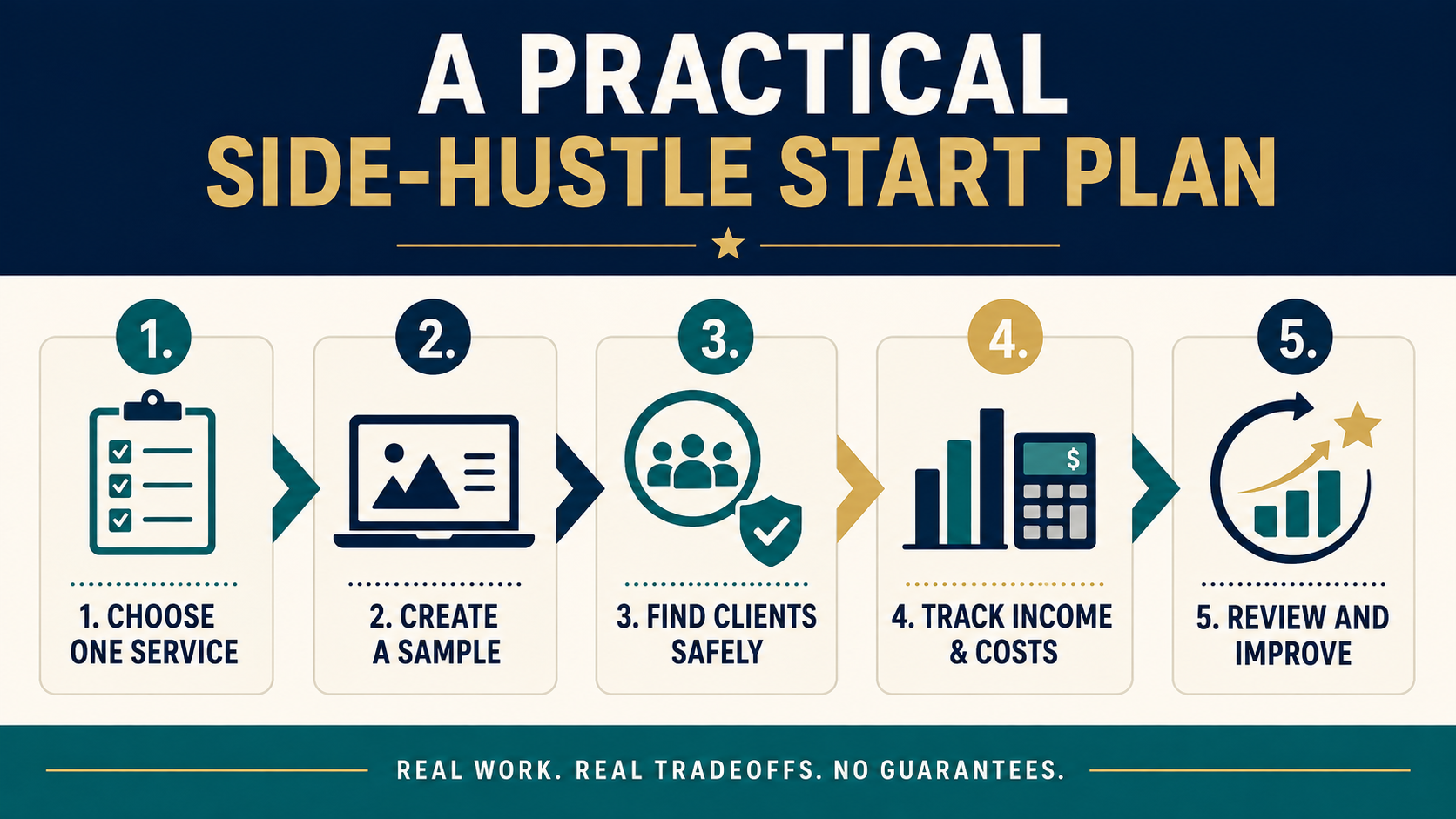
- Choose one service. Define the customer, deliverable, turnaround time, and what is outside the scope.
- Create one strong sample. Use a fictional brief or volunteer project if you do not yet have paid work, but label it honestly.
- Find clients safely. Try a reputable marketplace, professional network, local business outreach, or referrals. Verify identities and keep agreements in writing.
- Track income and costs. Record platform fees, software, supplies, mileage, shipping, refunds, and payment dates.
- Review and improve. After several projects, calculate net earnings per hour and decide whether to raise prices, narrow the offer, change channels, or stop.
Pricing Without Guesswork
A platform’s advertised rate may not be your take-home rate. Estimate the complete job: preparation, communication, delivery, revisions, payment fees, and follow-up. For a fixed-price project, divide net proceeds by all hours spent. If the result is below your acceptable threshold, adjust the scope, price, process, or client type.
New freelancers sometimes underprice to win reviews. A limited introductory offer can be reasonable, but set a clear end date and avoid open-ended revisions. Written proposals should define deliverables, deadlines, payment schedule, cancellation terms, and ownership rights.
Online Side Hustles Scams to Avoid
The Federal Trade Commission warns that scammers advertise work-from-home jobs through job boards, social media, texts, and messaging apps. A polished website or a check that appears to clear does not prove legitimacy. Banks can later identify a check as fake and reverse the deposit.
- Search the company name with words such as “scam,” “complaint,” and “review.”
- Use contact details found independently, not only those in the recruiter’s message.
- Do not provide a Social Security number or bank credentials before verifying a real employer and legitimate onboarding process.
- Reject jobs that ask you to receive and resend merchandise.
- Report suspected fraud at ReportFraud.ftc.gov.
U.S. Taxes and Recordkeeping
The IRS says income from gig, freelance, temporary, or side work is generally reportable even when it is paid in cash or no Form 1099 is issued. The reporting threshold for an information form does not determine whether income is taxable. Keep your own records rather than relying only on platform summaries.
Independent contractors may owe income tax and self-employment tax, and some people may need estimated tax payments. Eligible ordinary and necessary business expenses may reduce taxable profit, subject to tax rules and documentation. A separate checking account is not always legally required for a sole proprietor, but separating activity can make records easier to review.
Worker classification is fact-specific. A company calling someone a contractor does not settle the issue. Federal and state tests can differ, and U.S. Department of Labor guidance is subject to rulemaking. Consult current official guidance or a qualified tax or legal professional for your situation.
Protect Your Job and Personal Information
Review your employer’s policies on outside work, confidentiality, intellectual property, non-solicitation, and use of company equipment. Do not perform side-hustle work during paid employer time or reuse confidential materials. Use a separate email address, unique passwords, multifactor authentication, secure backups, and written payment milestones for large projects.
For related ideas and practical guides, browse MoneyVanta’s Making Money resources. A side hustle also works best when earnings have a purpose, such as debt repayment, emergency savings, or a planned investment contribution.
Frequently Asked Questions
What online side hustle can I start with no money?
A service based on equipment and skills you already have—such as writing, virtual assistance, tutoring, or simple design—may have little upfront cost. You still need to account for internet access, software, payment fees, and unpaid time spent finding customers.
How much can online side hustles make?
There is no reliable universal amount. Gross and net income vary with demand, experience, pricing, hours, platform fees, expenses, and customer retention. Track net earnings per hour using your own results instead of relying on promotional claims.
Do I need to pay taxes on side-hustle income?
Generally, U.S. taxpayers must report taxable side-hustle income even if they do not receive a tax form. Self-employment tax, estimated payments, deductions, and state obligations depend on the facts. Review current IRS guidance or consult a tax professional.
How can I tell if an online job is a scam?
Be suspicious of guaranteed income, vague duties, unexpected messages, pressure, advance fees, fake checks, reshipping, and requests for gift cards or cryptocurrency. Verify the organization independently and never pay money to receive wages.
Can I have a side hustle while employed full time?
Often yes, but review employment agreements and workplace policies. Avoid conflicts of interest, confidential information, company devices, and employer time. Also consider workload, benefits, classification, and applicable state law.
Bottom Line
Online side hustles are most useful when treated as measured work, not a shortcut. Choose one narrow offer, create evidence of quality, verify clients, price the complete workload, protect your information, and keep tax records. Continue only when the real net return justifies your time.
References
- Federal Trade Commission, Job Scams
- Federal Trade Commission, Task Scams Create the Illusion of Making Money
- Internal Revenue Service, Gig Economy Tax Center
- Internal Revenue Service, Taxable Income
- U.S. Department of Labor, Employee or Independent Contractor Classification