

Tax Refund Delays: 9 Reasons and What to Do Next
Tax refund delays can happen even when a return was accepted electronically. Most federal refunds arrive within the IRS’s typical timeframe, but errors, credit reviews, identity verification, amended returns, or payment issues can add time.
An accepted return is not the same as an approved refund. Acceptance generally means the IRS received the electronic filing and it passed initial checks. The agency may still need to verify income, credits, identity, or bank information before releasing money.

Key Takeaways
- The IRS says most electronically filed individual returns are processed within 21 days, but that is a general timeframe—not a promise.
- Common delays include return errors, refundable-credit reviews, identity verification, amended returns, injured-spouse claims, and paper processing.
- Use Where’s My Refund?, IRS2Go, or your IRS Online Account for personalized status information.
- Read and answer any IRS notice by its deadline using the approved response method.
- The IRS will not demand a fee, gift card, or cryptocurrency payment to “release” a refund.
How Long Do Federal Tax Refunds Usually Take?
The IRS currently describes the typical timeframe as about three weeks for an e-filed return and six weeks or more after it receives a mailed return. Some returns need corrections or special handling and take longer. Financial institutions can also require additional time after the IRS sends a direct deposit, particularly around weekends or holidays.
| Filing situation | When status may appear | General expectation | Important note |
|---|---|---|---|
| Current-year e-file | About 24 hours after e-filing | Most refunds in fewer than 21 days | Reviews or errors can extend processing |
| Prior-year e-file | About 3 days after e-filing | Varies by return | Older-year issues may require extra handling |
| Paper return | About 4 weeks after filing | Six weeks or more after receipt | Do not file a duplicate return merely because status is unavailable |
| Amended return | Use amended-return status tools | Usually longer than an original return | The IRS must compare the original and amended filings |
These are general IRS timeframes and may change. The status shown in your official account is more useful than a generic calendar estimate. Checking repeatedly during the same day does not accelerate processing; the IRS generally updates refund tools once daily, usually overnight.
9 Common Reasons for Tax Refund Delays
1. A Name, Number, Filing Status, or Math Error
A missing signature on a paper return, an incorrect Social Security number, a name mismatch, wrong filing status, or arithmetic error can stop automated processing. Some math corrections happen automatically, while other discrepancies require correspondence.
2. Income or Withholding Does Not Match IRS Records
Returns may be reviewed when reported wages, self-employment income, estimated payments, or withholding differ from Forms W-2, 1099, or other records received by the IRS. Filing before all tax documents arrive can create a mismatch.
3. Earned Income Tax Credit or Additional Child Tax Credit
Federal law prevents the IRS from issuing refunds on early-filed returns claiming the EITC or ACTC before mid-February. The hold applies to the entire refund, not only the portion connected to those credits. For 2026 filing-season returns without other issues, the IRS expected most qualifying direct-deposit refunds by March 2, 2026.
4. A Refundable Credit Needs Verification
The IRS may request documents to verify eligibility for the EITC, Child Tax Credit, Premium Tax Credit, or American Opportunity Tax Credit. If you receive a notice such as CP06 or CP75, follow its specific instructions. The refund can remain held while a credit audit is unresolved.
5. Identity Verification or Suspected Fraud
A return may be stopped when the IRS needs to confirm that the filer is the taxpayer. Use only the official method identified in a genuine IRS letter or your IRS account. The IRS does not initiate contact by email, text, or social media to demand passwords or financial credentials.
6. The Return Was Amended
Form 1040-X requires the IRS to compare the original return with the correction. Filing an amendment before the original return completes processing can complicate timing. Use the IRS amended-return tracker rather than the standard refund tool when appropriate.
7. Injured Spouse Relief Requires Manual Work
Form 8379 can be necessary when a joint refund may be applied to one spouse’s qualifying past-due debt and the other spouse seeks their share. The IRS identifies injured-spouse processing as a potential source of delay because it requires manual review.
8. The Refund Was Reduced or Offset
A refund may be applied to unpaid federal taxes or certain other debts, including past-due child support, qualifying federal nontax debt, or state income tax. The Bureau of the Fiscal Service generally sends a notice explaining a non-IRS offset. A smaller deposit is different from a refund that is still processing.
9. Direct-Deposit or Delivery Information Caused a Problem
Missing or incorrect routing and account numbers can prevent direct deposit. A financial institution may reject a deposit when the account information or name does not match its rules, and the IRS may need to issue another form of payment. A mailed check can also be lost, stolen, destroyed, or returned as undeliverable.
What to Do When Your Tax Refund Is Delayed
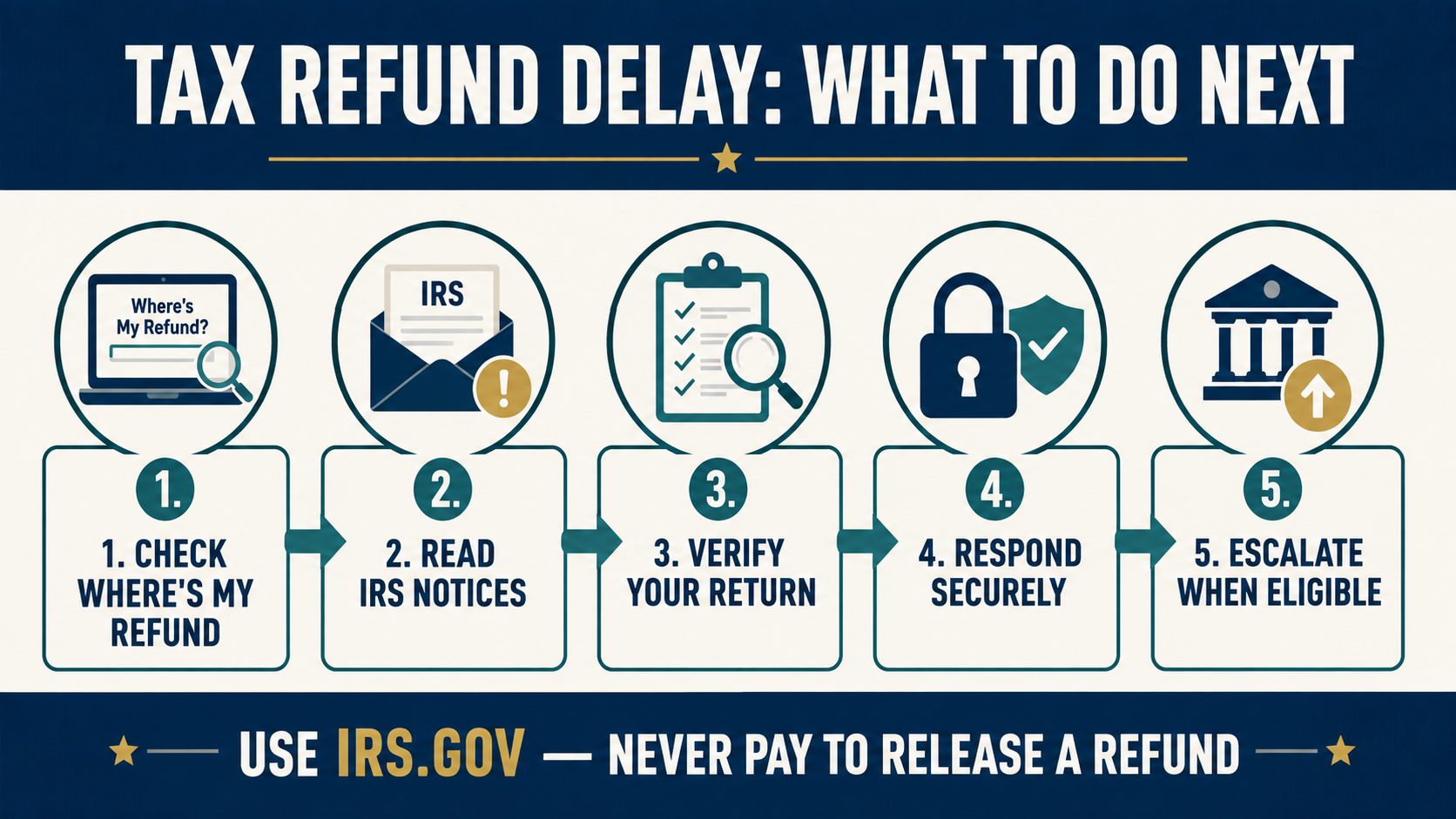
- Check the official tracker. Visit IRS.gov/Refunds, IRS2Go, or your IRS Online Account. Have the exact refund amount, filing status, tax year, and SSN or ITIN shown on the return.
- Read every notice. Match the notice number to IRS.gov and follow its deadline. Save copies of the notice and anything you submit.
- Verify the filed return. Compare names, identification numbers, dependents, credits, direct-deposit data, income documents, and withholding.
- Respond securely. Use the upload, mail, fax, or verification method specifically authorized in the notice. Never send documents to a contact supplied by an unsolicited message.
- Escalate when eligible. Contact the IRS only after the recommended waiting period or when the tracker instructs you to call. If an unresolved delay creates serious financial hardship, the Taxpayer Advocate Service may be able to help.
Understanding Common Refund Status Messages
| Status | What it generally means | Reasonable next step |
|---|---|---|
| Return Received | The IRS has the return and is processing it | Continue monitoring; avoid a duplicate filing |
| Refund Approved | The IRS approved the refund and may show an issue date | Allow time for the bank or mail |
| Refund Sent | Payment was transmitted or mailed | Check bank timing or follow refund-trace guidance if overdue |
| Still Being Processed | Processing is not complete; no single cause is implied | Follow any on-screen instructions and watch for mail |
| Action Needed | The IRS needs information or verification | Use the reference number and official directions shown |
A generic message does not diagnose the return. Only the taxpayer-specific tracker, account transcript, or IRS correspondence can clarify the next action. A tax preparer may help interpret the return, but cannot force the IRS to release a refund.
Tax Refund Delay Scams
Scammers exploit refund anxiety with texts, emails, calls, and fake websites. They may claim your refund is frozen and ask you to click a link or “verify” bank credentials. Type IRS.gov directly into your browser. Do not trust a phone number or link in an unexpected message.
When the Taxpayer Advocate Service May Help
The Taxpayer Advocate Service is an independent organization within the IRS. It may help when a taxpayer is experiencing economic harm, faces an immediate threat of adverse action, has tried normal channels without resolution, or meets other case criteria. TAS cannot override legal refund holds, including the mid-February rule for early EITC and ACTC claims.
For a guide focused specifically on status tools, read MoneyVanta’s Where’s My Refund? guide. You can also browse our Taxes resources.
Frequently Asked Questions
Why is my tax refund taking longer than 21 days?
A return may need error correction, income matching, identity verification, credit review, amended-return processing, or other special handling. Twenty-one days is a typical timeframe for many e-filed returns, not a guaranteed deadline.
Does “accepted” mean my refund is approved?
No. Acceptance generally confirms that the IRS received the e-filed return and it passed initial checks. The refund can still be reviewed before approval and payment.
Should I file my return again if my refund is delayed?
Usually no. A duplicate return can create additional processing problems. File again or amend only when IRS guidance, your notice, or a qualified professional indicates that a correction is required.
Can the IRS tell me the exact refund date by phone?
Often the automated tracker provides the same or more current information. Call when the tracker instructs you to, the relevant waiting period has passed, or an IRS notice requires a response.
Can financial hardship speed up a delayed refund?
Hardship does not automatically release a refund, and legal holds cannot be bypassed. The Taxpayer Advocate Service may assist eligible taxpayers facing significant economic harm after normal channels have not resolved the issue.
Bottom Line
Tax refund delays are frustrating, but the safest response is systematic: check the official status, review the filed return, read every IRS notice, answer securely, and escalate only when eligible. Avoid duplicate filings and anyone demanding payment to release your money.
References
- Internal Revenue Service, Refunds
- Internal Revenue Service, Processing Status for Tax Forms
- Internal Revenue Service, Ways to Check a Tax Refund
- Internal Revenue Service, EITC and ACTC Refund Timing
- Taxpayer Advocate Service, Held or Stopped Refunds