IRS Tax Refunds: How to Track Your Refund and Avoid Delays
IRS Tax Refunds: How to Track Your Refund and Avoid Delays
An IRS tax refund is paid when your federal tax payments and refundable credits exceed the tax shown on your return. The fastest official way to check the status is Where’s My Refund? after the IRS has received your return. Most electronic refunds are issued in fewer than 21 days, but no individual refund date is guaranteed.
Key Takeaways
- Where’s My Refund? is generally available 24 hours after e-filing a current-year return.
- The IRS issues most refunds in fewer than 21 days; mailed returns and returns requiring review can take longer.
- Direct deposit is generally the fastest payment method when account details are correct.
- Returns claiming EITC or ACTC are held by law until at least mid-February.
- Use IRS.gov, IRS2Go, or your IRS Online Account—not links in unsolicited messages—to check status.

Tax Information Notice
This article is general information, not personalized tax, financial, investment, or legal advice. Your refund timing and amount depend on your tax return, income, credits, payments, verification requirements, and potential offsets. Consult a CPA, Enrolled Agent, or other qualified tax professional for advice on your situation.
How IRS Tax Refunds Work
When you file Form 1040, the IRS compares the tax you owe with withholding, estimated tax payments, and refundable credits. An overpayment may become a refund. The IRS may adjust the amount if it finds a math error, receives wage information that does not match the return, or applies all or part of the overpayment to eligible debts.
A refund is not a prize or a promise of the same result next year. It can change when pay, withholding, filing status, dependents, deductions, credits, or federal rules change. A large refund can also mean more tax was withheld during the year than necessary, although refundable credits can affect the result as well.
How to Check an IRS Tax Refund
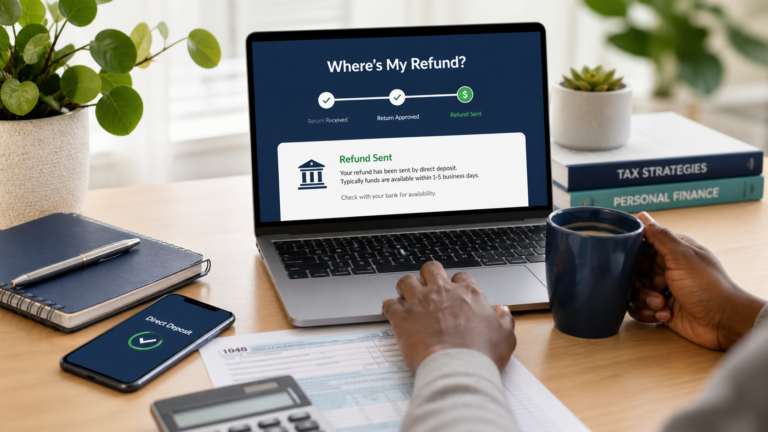
Start with the official Where’s My Refund? tracker. To use it without signing in, you need the exact whole-dollar refund amount, Social Security number or ITIN, filing status, and tax year. You can also check through an IRS Individual Online Account, the IRS app, or the IRS refund hotline at 800-829-1954.
For a current-year electronic return, refund status is generally available about 24 hours after e-filing. For a prior-year electronic return, it is generally available after three days; a paper return may take about four weeks to appear in the tracker. The status tools usually update once each day, often overnight.
| Situation | Official timing guidance | Practical next step |
|---|---|---|
| Current-year e-file | Status generally available after 24 hours | Use Where’s My Refund? with your exact return information |
| Prior-year e-file | Status generally available after 3 days | Confirm the tax year before tracking |
| Paper return | Status generally available after about 4 weeks | Allow mailing and intake time before checking |
| Most standard e-file refunds | Usually issued in fewer than 21 days | Do not rely on a specific deposit date |
Why an IRS Refund May Be Delayed
Some refunds require additional work. This does not automatically mean an audit. Common reasons include an incomplete return, a math or data-entry error, identity verification, inconsistent information, an amended return, an injured-spouse claim, or missing direct-deposit information. If the IRS needs something, it normally sends a letter by mail with next steps.
- Return accuracy: E-file and review W-2, 1099, dependent, and bank information before submitting.
- Identity and fraud screening: Extra review can protect taxpayers from fraudulent refund claims but may add time.
- Bank processing: After IRS sends a payment, the financial institution may need additional time to make it available.
- IRS adjustment or offset: A notice should explain an amount changed by the IRS or applied to eligible debt.
EITC and ACTC Refund Timing
Federal law prevents the IRS from issuing refunds for returns claiming the Earned Income Tax Credit (EITC) or Additional Child Tax Credit (ACTC) before mid-February. The hold applies to the entire refund, not only the portion connected to the credit. For the 2026 filing season, the IRS said most early e-filed EITC/ACTC returns with direct deposit and no issues could expect funds by March 2, 2026. That was a season-specific estimate; use the current IRS tracker for a personalized date.
Direct Deposit and Refund Security
Electronic filing with direct deposit is generally the fastest way to receive an IRS refund. Review routing and account numbers carefully before filing, and use an account permitted under IRS rules. The IRS has been phasing out paper tax refund checks, subject to applicable exceptions, so electronic payment information is increasingly important.
Watch for scams. The IRS does not initiate contact by text, social media, or email to ask for personal information or a fee to “release” a refund. Start from IRS.gov rather than following a message link. If you receive a refund you did not expect, do not spend it; review IRS guidance on returning an erroneous refund.
What to Do After a Status Update
If the tracker shows “refund sent,” verify the expected payment method and allow your financial institution time to post the deposit. If it instructs you to contact the IRS, use the number or steps displayed there. If you receive an IRS letter, compare it with your filed return and respond by the stated deadline. Keep a copy of your return, notices, and supporting records.
IRS Refund Offsets
Some overpayments may be applied to past-due federal taxes or certain other qualifying obligations, such as state income tax, child support, state unemployment compensation debt, or eligible federal nontax debt. The Treasury Offset Program and the IRS handle different parts of this process. A taxpayer generally receives a notice explaining an offset and the agency involved.
An offset can reduce the amount deposited even when Where’s My Refund? indicates a refund was sent. Read any IRS or Treasury notice before assuming there has been a bank error. If you disagree with the underlying debt, contact the agency named in the notice rather than the IRS alone.
Frequently Asked Questions
When can I use Where’s My Refund?
For a current-year electronically filed return, the IRS says refund information is generally available after 24 hours. Paper returns and prior-year returns take longer to appear.
Why is my IRS refund taking more than 21 days?
Your return may require correction, identity verification, credit review, manual processing, or an adjustment. Follow the tracker’s instructions and wait for a letter if the IRS needs information.
Does Where’s My Refund track amended returns?
No. Use the IRS amended-return status tool for Form 1040-X instead. Amended returns generally require more processing time than original returns.
Can the IRS take my refund for debt?
Possibly. Eligible federal, state, and other government-referred debts can reduce an overpayment. You should receive a notice describing the offset and the agency to contact.
Should I call the IRS every day about my refund?
No. The IRS advises using Where’s My Refund? and contacting the IRS only when the tool tells you to do so. The status generally updates once a day.
Bottom Line
IRS Tax Refunds are best tracked through official tools, not estimates or social-media timelines. E-file accurately, select direct deposit when appropriate, protect your personal information, and use Where’s My Refund? for the most relevant status update.
If processing takes longer than expected, follow the tracker and IRS correspondence carefully. A delay may reflect a correction or security review rather than a lost refund.
References
- Internal Revenue Service — Refunds
- Internal Revenue Service — Where’s My Refund?
- Internal Revenue Service — Ways to Check Tax Refund Status
- Internal Revenue Service — EITC and ACTC Refund Timing
- U.S. Treasury, Bureau of the Fiscal Service — Treasury Offset Program
- Internal Revenue Service — Returning an Erroneous Refund