
Checking accounts with no monthly fee can lower the routine cost of everyday banking, but “no monthly fee” does not always mean every service is free. The right account pairs a $0 maintenance charge with practical ATM access, sensible overdraft rules, useful digital tools, and federal deposit insurance.
Checking Accounts With No Monthly Fee: A Smart Guide

- A true no-monthly-fee checking account does not charge a recurring maintenance or service fee.
- Other costs can still apply, including out-of-network ATM, overdraft, wire, stop-payment, dormant-account, or check-order fees.
- Compare the fee schedule, ATM network, overdraft policy, deposit methods, customer support, and minimum opening deposit.
- Confirm that a bank is FDIC-insured or a credit union is federally insured by the NCUA.
- Account terms can change, so review current disclosures before opening or moving an account.
What Are Checking Accounts With No Monthly Fee?
A checking account with no monthly fee is a transaction account that does not charge a recurring maintenance fee simply for keeping the account open. You can generally use it for direct deposit, bill payments, debit-card purchases, transfers, checks, and cash withdrawals, depending on the institution.
The distinction between no monthly fee and a waivable monthly fee matters. Some accounts charge $10 or $15 each month unless you meet a condition such as receiving a qualifying direct deposit or maintaining a stated balance. That account may cost nothing in months when you qualify, but it is not unconditionally fee-free. A true $0-monthly-fee account has no recurring maintenance charge to waive.
The Consumer Financial Protection Bureau explains that when an account is advertised as “free” or “no cost,” it cannot impose monthly service fees, fees for exceeding a transaction limit, or a fee for failing to maintain a minimum balance. However, specific service fees may still apply.
No Monthly Fee Does Not Mean No Fees
The monthly maintenance fee is only one line in a deposit account agreement. Before opening an account, read the full fee schedule and ask how the institution handles transactions that exceed your available balance.
| Feature or fee | What to check | Why it matters |
|---|---|---|
| Monthly maintenance | Is it always $0, or only waived after meeting conditions? | Missing a direct-deposit or balance requirement can trigger a charge. |
| Overdraft and NSF | Are transactions declined, covered for a fee, or paid from a linked account? | One overdraft charge can outweigh months of maintenance-fee savings. |
| ATM access | Network size, operator surcharges, and reimbursement policy | Frequent cash users may pay more outside the network. |
| Paper services | Checks, statements, cashier’s checks, and stop payments | Digital-first accounts may charge for optional paper services. |
| Transfers and wires | Standard ACH, expedited transfers, domestic wires, and international wires | Transfer costs vary substantially by method and institution. |
| Opening requirements | Minimum opening deposit and identity or membership requirements | A $0 monthly fee does not guarantee a $0 opening deposit. |
How to Choose a No-Monthly-Fee Checking Account
1. Confirm how the monthly fee works
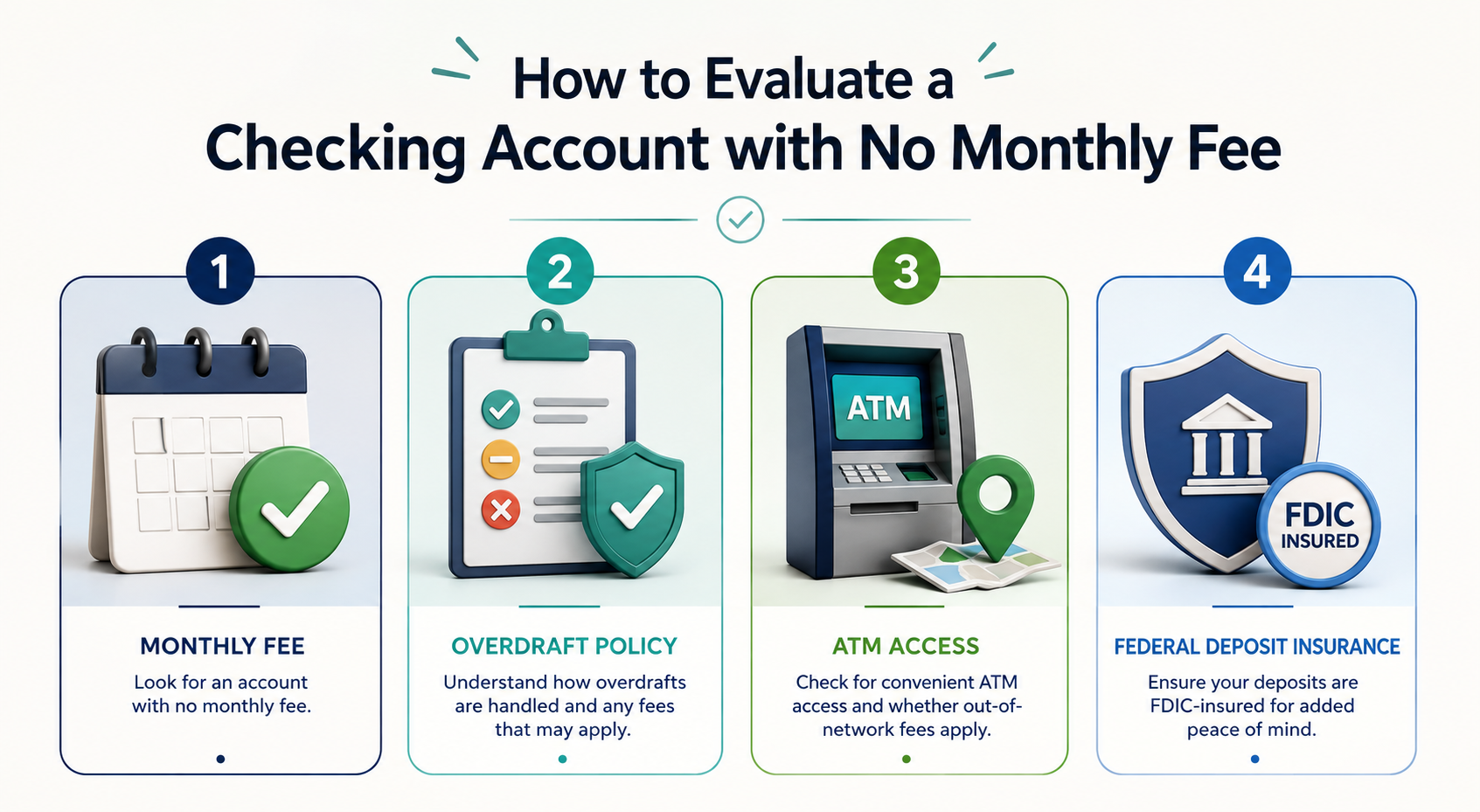
Look for plain language such as “$0 monthly maintenance fee.” If the account lists a fee that can be waived, write down every waiver requirement. Consider whether your income schedule, average balance, or account activity will reliably meet it. An unconditional $0 charge is often easier to manage when income changes from month to month.
2. Study the overdraft policy
Overdraft occurs when a payment exceeds the money available in your account. Ask whether the bank declines debit-card transactions, offers an optional paid overdraft service, links to savings, or provides a small buffer. Under federal Regulation E, a financial institution generally cannot charge an overdraft fee for an ATM or one-time debit-card transaction unless the consumer affirmatively opts in. Different rules may apply to checks, ACH payments, and recurring transactions.
A lower-risk setup may be preferable if you keep a narrow balance. Alerts, automatic savings transfers, and the ability to turn off certain overdraft services can help, but you still need to monitor pending transactions and holds.
3. Match the ATM network to your habits
An online account may offer a large surcharge-free network but no branches. A local bank or credit union may have convenient branches but fewer ATMs when you travel. Check both sides of an out-of-network withdrawal: your institution may charge a fee, and the ATM owner may add a separate surcharge. Cash-deposit access also matters if you are paid in cash.
4. Compare digital tools and customer support
Useful features can include mobile check deposit, real-time transaction alerts, debit-card controls, bill pay, budgeting categories, early direct deposit, person-to-person transfers, and access to a human representative. Early direct deposit is not guaranteed; availability depends on when the payer sends information and the institution’s policy.
5. Verify federal deposit insurance
Checking deposits at an FDIC-insured bank are generally insured up to at least $250,000 per depositor, per insured bank, for each account ownership category. Qualifying accounts at federally insured credit unions receive comparable coverage through the National Credit Union Share Insurance Fund, administered by the NCUA. Coverage depends on account ownership and institution status, not on an app’s design or marketing.
Use the FDIC’s BankFind tool or the NCUA’s credit union locator and insurance resources to verify coverage. If a fintech app is not itself a bank, read its disclosures carefully to understand which partner bank may hold deposits and whether pass-through insurance requirements are satisfied.
Where These Accounts Are Commonly Offered
No-monthly-fee checking is available through several types of institutions. Online banks often operate without large branch networks and may offer broad ATM access. Credit unions may provide low-cost accounts, although membership eligibility can apply. Community and regional banks may offer local service. Some large banks offer basic accounts with no monthly charge, while others make the charge waivable through direct deposit or balance requirements.
Fintech apps can provide checking-like services through partner banks. The legal account structure, customer-service responsibilities, deposit insurance arrangement, and access to cash may differ from a traditional bank relationship. Do not assume every money app is a bank or that every balance is automatically insured.
Who Benefits From Checking Accounts With No Monthly Fee?
- People with variable income: An unconditional $0 maintenance fee avoids relying on a monthly direct-deposit threshold.
- Students and first-time account holders: A simple fee structure can make cash flow easier to understand.
- Budget-conscious households: Removing a predictable recurring cost preserves money for essential spending or savings.
- People comfortable with digital banking: Online institutions may trade branch access for lower routine costs.
- Secondary-account users: A fee-free account may work for bills, travel, or a specific savings workflow without creating another recurring charge.
A no-fee account may be less suitable if it lacks the branches, cash services, accessible support, international capabilities, or business features you frequently need. The lowest monthly charge is not automatically the lowest total cost.
A Simple Annual Cost Comparison
Suppose Account A charges a $12 monthly maintenance fee unless you meet a waiver requirement, while Account B charges no monthly maintenance fee. If you miss Account A’s waiver every month, the annual maintenance cost is:
If Account B causes four $4 out-of-network ATM charges while Account A offers convenient free ATMs, the gap narrows by $16. This is why comparing your likely total annual cost is more useful than focusing on a single advertised feature.
How to Switch Checking Accounts Safely
- Open and verify the new account. Confirm deposit insurance, disclosures, access methods, and any opening deposit.
- Move direct deposits. Update payroll, benefits, and other incoming payments. Wait until a deposit reaches the new account successfully.
- Redirect automatic payments. Review several months of statements so annual or infrequent charges are not missed.
- Keep a temporary cushion. Leave enough in the old account for outstanding checks, card holds, and delayed debits.
- Download records. Save statements and tax documents you may need later.
- Close the old account deliberately. After all activity has moved, follow the institution’s closure process and obtain confirmation.
For more background, compare MoneyVanta’s guides to free checking accounts and checking accounts with no minimum balance.
Common Mistakes to Avoid
- Confusing a waived fee with an account that never charges a monthly fee.
- Ignoring overdraft, ATM, paper-statement, wire, or dormant-account charges.
- Choosing an account based only on a temporary cash bonus.
- Assuming a fintech company is an FDIC-insured bank without checking the deposit arrangement.
- Closing an old account before outstanding payments and direct deposits have moved.
- Leaving alerts off and relying only on the displayed balance instead of available funds and pending activity.
Frequently Asked Questions
Are checking accounts with no monthly fee really free?
They can have no recurring maintenance charge, but other fees may still apply. Review charges for overdrafts, out-of-network ATMs, wires, checks, stop payments, paper statements, and dormant accounts.
Do no-monthly-fee checking accounts require direct deposit?
Some do not. Others advertise a monthly fee that becomes $0 only when you meet a direct-deposit or balance condition. Check whether the fee is unconditionally $0 or merely waivable.
Can a free checking account charge an overdraft fee?
Yes. CFPB guidance says a “free” account may still charge certain fees, including overdraft or bounced-check fees. The institution must disclose applicable terms, and federal opt-in rules cover certain ATM and one-time debit-card overdrafts.
Are online no-fee checking accounts FDIC-insured?
Many are, but verify the institution. FDIC insurance applies to eligible deposits at an FDIC-insured bank. If an app uses a partner bank, read the deposit and pass-through insurance disclosures carefully.
What is the difference between no monthly fee and no minimum balance?
No monthly fee concerns the recurring maintenance charge. No minimum balance means you do not need to keep a specified balance to open the account, avoid a fee, or earn features, depending on the account’s exact wording. An account may offer one benefit without the other.
Bottom Line
Checking accounts with no monthly fee can be a strong everyday banking option, especially when income or balances fluctuate. The best fit is the account whose total costs, ATM access, overdraft approach, deposit options, support, and insurance align with your real habits.
References
- Consumer Financial Protection Bureau, Free checking accounts and permitted fees.
- Consumer Financial Protection Bureau, Monthly maintenance fees.
- Consumer Financial Protection Bureau, Regulation E § 1005.17: overdraft services.
- Federal Deposit Insurance Corporation, Deposit Insurance.
- National Credit Union Administration, Frequently Asked Questions About Share Insurance.