Checking Accounts With No Minimum Balance: 2026 Guide
Checking Accounts With No Minimum Balance: What to Know
Checking accounts with no minimum balance let you keep the account open—or avoid a balance-based fee—without maintaining a required dollar amount. That flexibility can help when income is irregular or cash needs to stay available, but it does not automatically mean the account is free of every fee.
Checking accounts with no minimum balance can simplify everyday banking, provided you compare the complete fee schedule and confirm federal deposit insurance.

Key Takeaways
- “No minimum balance” may refer to the amount required to open an account, the balance needed to keep it open, or the balance needed to avoid a monthly fee—verify all three.
- A no-minimum-balance checking account may still charge monthly maintenance, out-of-network ATM, overdraft, stop-payment, wire, or paper-statement fees.
- If an account is advertised as “free” or “no cost,” federal rules restrict certain recurring and transaction-based charges, although other fees may still apply.
- Confirm that a bank is FDIC-insured or a credit union is federally insured by the NCUA before depositing money.
- Compare practical access—ATMs, cash deposits, customer support, mobile tools, and bill pay—not just the headline balance requirement.
A bank account without a minimum balance can be useful for students, people paid by gig work, anyone rebuilding an emergency fund, or households whose checking balance changes sharply between paydays. The strongest option is not simply the account with the lowest requirement; it is the account whose total fees and access features match how you actually bank.
For related guidance, see MoneyVanta’s Banking resources and our guide to free checking accounts.
What Does “No Minimum Balance” Mean?
The phrase can describe several different account terms. A bank may require no minimum opening deposit but impose a monthly fee unless your average balance stays above a threshold. Another institution may let the balance fall to $0 without closing the account, yet charge a maintenance fee. A third account may have neither a minimum balance nor a monthly fee.
Read the account-opening disclosure and fee schedule before applying. Under the Truth in Savings framework, depository institutions disclose fees, interest rates, and key terms. Pay particular attention to how the institution calculates a balance requirement: daily balance, minimum daily balance, or average monthly balance can produce different results.
| Term | What it generally means | Question to ask |
|---|---|---|
| No minimum opening deposit | You may open the account without funding it immediately, subject to the institution’s rules. | When must the first deposit arrive to keep the account active? |
| No minimum balance | You are not required to maintain a specified balance for the stated purpose. | Does this apply to account eligibility, monthly fees, or both? |
| Monthly fee can be waived | A recurring fee may disappear after meeting conditions such as direct deposit or a balance threshold. | What happens in any month when the condition is missed? |
| Free checking | The account cannot impose certain maintenance or basic activity fees when advertised as free, but incidental fees may remain. | Which ATM, overdraft, check, wire, and statement fees still apply? |
No Minimum Balance vs. Free Checking
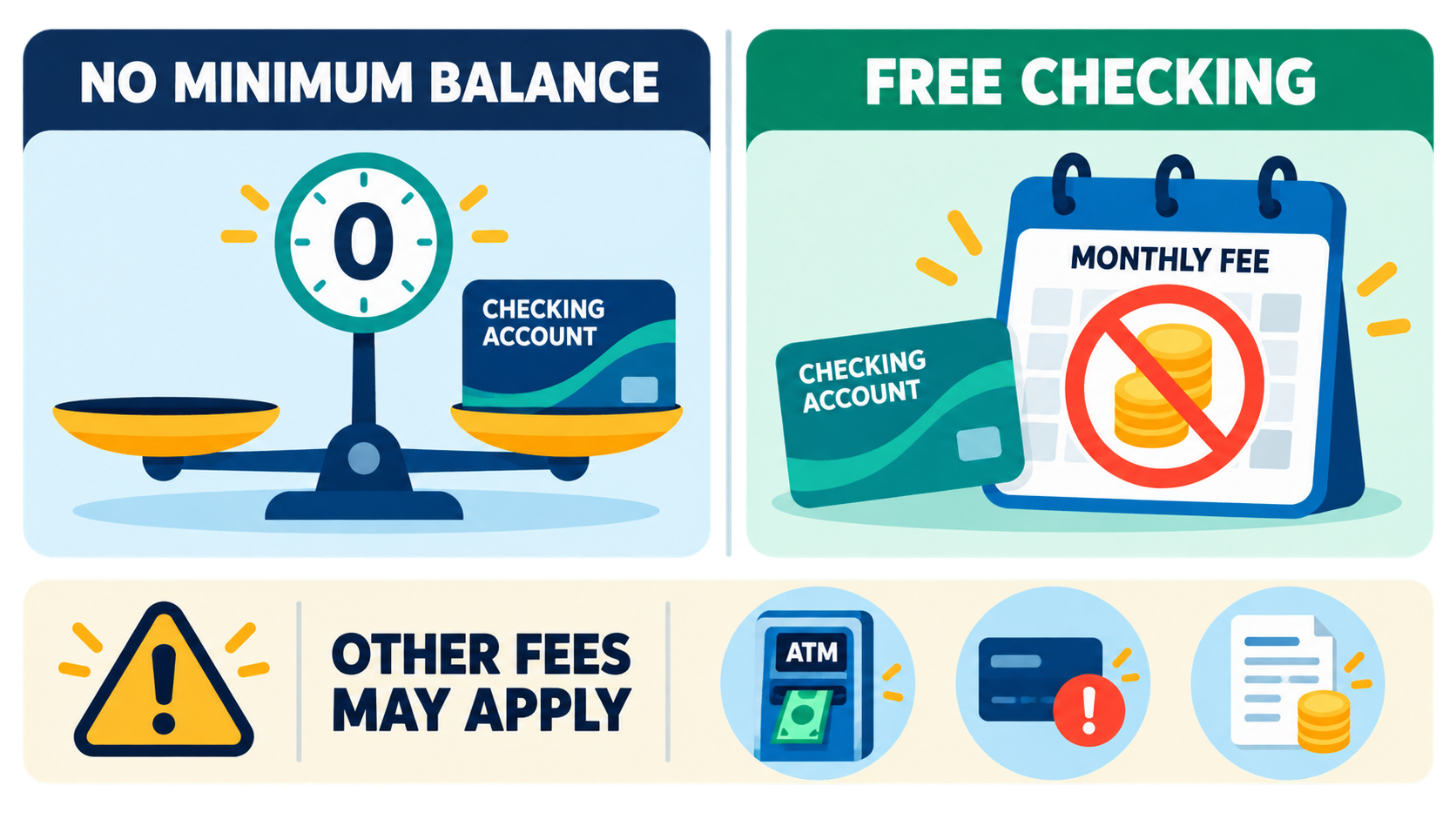
The Consumer Financial Protection Bureau explains that an account described as “free” or “no cost” cannot charge a monthly service fee, charge for exceeding a specified number of transactions, or charge a fee merely because the customer did not meet a minimum balance. However, a free account may still impose charges for out-of-network ATMs, overdrafts, returned items, stop payments, dormant accounts, balance inquiries, or printed checks.
By contrast, “no minimum balance” addresses a balance rule rather than every possible cost. If the product page says “$0 minimum balance” but lists a monthly maintenance fee, the account is not necessarily free. Look for a clear “$0 monthly fee” statement and then review the exceptions.
Fees on Checking Accounts With No Minimum Balance
Monthly maintenance fee
Some accounts charge a flat monthly amount unless you receive qualifying direct deposits, make a required number of debit-card purchases, or maintain another relationship with the institution. Decide whether the waiver condition fits your normal routine rather than planning to change your behavior around it.
Overdraft and nonsufficient-funds fees
An overdraft happens when the institution pays a transaction even though the account lacks sufficient funds. An NSF fee may apply when a check or certain electronic payment is returned unpaid. Policies vary widely. For one-time debit-card and ATM overdrafts, a financial institution generally must obtain your opt-in before charging an overdraft fee, but different rules may apply to checks and recurring electronic payments.
ATM and cash-access costs
An account may be inexpensive online but costly if you regularly use out-of-network ATMs. Check both the institution’s fee and any fee charged by the ATM owner. If you receive cash income, confirm where and how cash deposits are accepted and whether a fee applies.
Service and convenience charges
Review fees for paper statements, cashier’s checks, stop-payment requests, wire transfers, replacement debit cards, foreign transactions, and expedited delivery. You may rarely use these services, but one charge can outweigh several months of maintenance-fee savings.
Who May Benefit From a No-Minimum-Balance Account?
- People with variable income: Freelancers, seasonal workers, and gig workers may not keep the same balance throughout the month.
- Students and early-career workers: A low balance requirement can reduce the risk of a fee while income and expenses are still changing.
- Households using multiple accounts: A dedicated bills or spending account may naturally run close to $0 after scheduled payments.
- Consumers moving away from prepaid cards: An insured checking account may add check writing, bill pay, and broader ATM access, depending on the institution.
- Anyone prioritizing liquidity: Money does not need to sit idle solely to satisfy an account rule.
A no-minimum option may be less attractive if it lacks branches you need, makes cash deposits difficult, provides weak customer service, or charges high incidental fees. Also compare interest-bearing checking only if you can meet its conditions; a small yield may not compensate for avoidable charges.
How to Compare Checking Accounts With No Minimum Balance
- Define your banking habits. Estimate monthly debit purchases, ATM withdrawals, cash deposits, transfers, checks, and customer-support needs.
- Separate the three minimums. Confirm the opening deposit, the balance required to avoid fees, and the balance required to keep the account open.
- Calculate likely annual cost. Add monthly fees you realistically expect, plus probable ATM, statement, and service charges. Do not treat a waiver as guaranteed if your deposits vary.
- Review overdraft choices. Ask whether transactions are declined, paid for a fee, covered by a linked account, or covered by a line of credit. Each option can have a cost.
- Confirm deposit insurance. Use the FDIC’s BankFind tool for banks or the NCUA’s credit-union locator for federally insured credit unions. Coverage depends on institution and ownership category.
- Test access and support. Check mobile deposit limits, bill pay, transfer speed, ATM availability, cash-deposit options, accessibility, and support hours.
- Save the disclosures. Keep the fee schedule and account agreement available so you can recognize later changes.
Simple annual-cost example
Suppose Account A has no minimum balance but a $7 monthly fee, while Account B has no monthly fee but you expect two $3 out-of-network ATM charges each month. The illustrative annual cost is $84 for Account A ($7 × 12) and $72 for Account B ($3 × 2 × 12). This example excludes overdrafts, third-party ATM surcharges, checks, wires, and changing terms; your actual cost depends on your behavior and the institution’s disclosures.
Deposit Insurance and Account Safety
Checking deposits at an FDIC-insured bank are automatically insured to at least $250,000 per depositor, per insured bank, for each ownership category. At a federally insured credit union, the National Credit Union Share Insurance Fund generally provides similar coverage of at least $250,000 for qualifying share accounts. Coverage rules can become more complex for joint, trust, retirement, and business accounts.
Insurance protects eligible deposits if an insured institution fails; it does not reimburse ordinary fraud caused by sharing credentials, investment losses, or every fintech balance. If an app is not itself a bank, identify the partner bank, understand how records are maintained, and verify whether pass-through insurance requirements are satisfied. Do not rely only on a marketing logo.
Common Mistakes to Avoid
- Assuming “$0 to open” also means no monthly maintenance fee.
- Choosing an account for a sign-up promotion without checking the long-term fee schedule.
- Opting into overdraft coverage without understanding alternatives and costs.
- Ignoring cash-deposit or out-of-network ATM fees.
- Keeping more than insurance limits in one ownership category without reviewing coverage.
- Opening a fintech account without confirming where deposits are actually held.
Frequently Asked Questions
Can a checking account have no minimum balance but still charge a monthly fee?
Yes. “No minimum balance” may only mean that a specific balance is not required. The account can still have a monthly maintenance fee unless the disclosure says otherwise. Check both the balance rule and the complete fee schedule.
Is no minimum opening deposit the same as no minimum balance?
No. No minimum opening deposit concerns the amount needed to start the account. A separate balance requirement may apply later to avoid a fee or keep the account active.
Are no-minimum-balance checking accounts FDIC insured?
They can be, provided the account is a qualifying deposit at an FDIC-insured bank. Checking accounts at federally insured credit unions may instead receive NCUA share insurance. Verify the institution and ownership category.
Do no-minimum-balance accounts allow overdrafts?
Policies vary. An institution may decline a transaction, pay it and charge a fee, or offer linked-account protection. Review the opt-in choice and the treatment of debit cards, checks, ACH payments, and recurring transactions.
What credit score is needed to open a checking account?
A traditional credit score is usually not the main factor, but institutions may review identity information and specialized checking-account reports. Approval standards differ, and some banks or credit unions offer second-chance accounts.
Bottom Line
Checking accounts with no minimum balance can reduce one common barrier to everyday banking, but the phrase does not tell you the account’s total cost. Compare monthly fees, waiver conditions, overdraft policy, ATM access, cash-deposit options, support, and deposit insurance together.
Before applying, read the current account agreement and fee schedule and choose terms that fit your normal cash flow—not an ideal month.
References
- Consumer Financial Protection Bureau, Can a “free” checking account still have fees?
- Consumer Financial Protection Bureau, Monthly maintenance fees for deposit accounts
- Federal Deposit Insurance Corporation, Overdraft and Account Fees
- Federal Deposit Insurance Corporation, Deposit Insurance
- MyCreditUnion.gov, NCUA Share Insurance