
Biweekly Budgeting: How to Budget Every Two Weeks
Biweekly Budgeting: A Paycheck-by-Paycheck Guide
Biweekly budgeting assigns every paycheck a job for the next 14 days. Instead of forcing two-week income into a calendar-month plan, you match bills, essentials, savings, and flexible spending to the dates money actually arrives.
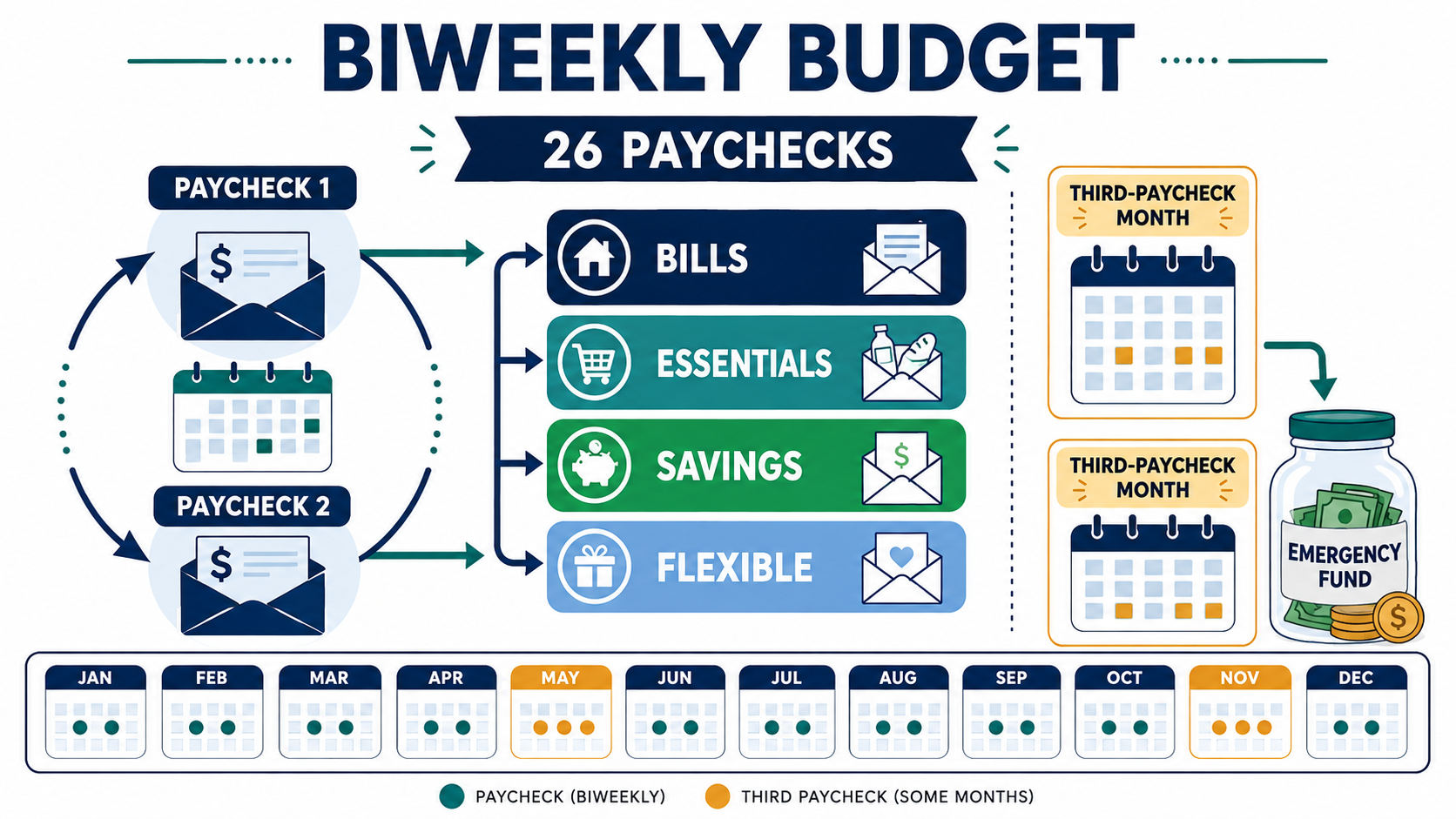
Biweekly budgeting works best when you map all monthly due dates first, reserve part of each paycheck for large bills, and plan how to use the two additional paychecks that typically occur during a 26-paycheck year.

Key Takeaways
- Most biweekly employees receive 26 paychecks per year, not exactly two per month; two months commonly contain a third paycheck.
- Build the plan from net pay—the amount deposited after taxes, insurance, and payroll deductions.
- List bills by due date, then divide large monthly obligations across both regular paychecks when practical.
- Create sinking funds for irregular costs such as car repairs, annual subscriptions, holidays, and insurance premiums.
- Treat a third paycheck as planned income, not automatically as free spending; its job depends on upcoming bills and priorities.
What Is Biweekly Budgeting?
A biweekly pay schedule provides a paycheck every other week, usually on the same weekday. Because 52 weeks divided by two equals 26, a full year normally includes 26 paychecks. That differs from semimonthly pay, which arrives twice per month on fixed dates and produces 24 checks per year.
A biweekly budget is a cash-flow plan. It focuses not only on total income and expenses but also on timing. The Consumer Financial Protection Bureau describes cash flow as the timing of money coming in and going out. Matching those dates can reduce the risk of running short before the next payday even when monthly income appears sufficient on paper.
| Pay schedule | Typical frequency | Budgeting implication |
|---|---|---|
| Weekly | Usually 52 paychecks per year | Short planning periods; some months have five paydays. |
| Biweekly | Usually 26 paychecks per year | Two checks most months and a third check in two months. |
| Semimonthly | 24 paychecks per year | Two fixed pay dates each month; check amounts may be more consistent. |
| Monthly | 12 paychecks per year | One deposit must cover the entire month’s obligations. |
How to Build a Biweekly Budgeting Plan
1. Start with take-home pay
Use the net amount that reaches your account, not gross salary. If overtime, commissions, tips, or shift premiums vary, base essential commitments on a conservative amount you can reasonably expect. Treat higher-than-usual income as a separate decision after core needs are covered.
2. Put every bill on a calendar
Gather statements and list each due date and expected amount. The CFPB’s bill-calendar method recommends placing both income dates and bill dates on one calendar so timing gaps become visible. Include rent or mortgage, utilities, insurance, debt minimums, phone, internet, child care, and subscriptions.
3. Separate fixed, variable, and irregular expenses
Fixed bills are predictable obligations. Variable essentials include groceries, gasoline, household supplies, and utilities that change. Irregular expenses are real but do not occur every pay period—vehicle registration, annual memberships, medical costs, gifts, and home maintenance are common examples.
4. Assign expenses to Paycheck 1 and Paycheck 2
Pay bills due before the following payday from the current check. For a large monthly obligation, you may reserve half from each regular paycheck. Keep that reserved money in a separate bills account or clearly labeled budget category so it is not mistaken for spending money.
5. Fund savings and sinking funds
Savings can be treated as a planned expense. Automating a manageable transfer shortly after payday may support consistency, but leave enough checking-account cushion to avoid overdrafts. A sinking fund holds smaller contributions for a known future expense; an emergency fund is for unplanned financial shocks.
6. Set a 14-day flexible-spending limit
After bills, essentials, debt payments, and savings, divide the remaining flexible amount across the two weeks. Weekly mini-limits can make mid-cycle adjustments easier. Track actual purchases and revise the next cycle rather than treating one overage as failure.
Biweekly Budgeting Example
Assume take-home pay is $2,000 every two weeks. The example below covers one typical 14-day cycle. It is illustrative, uses round numbers, and does not prescribe how much any household should spend or save.
| Category | Amount | How it is used |
|---|---|---|
| Half of monthly housing | $700 | Reserved so two regular paychecks provide $1,400 for housing. |
| Utilities, phone, and insurance | $250 | Bills due before the next payday or amounts reserved for upcoming dates. |
| Groceries and household needs | $300 | Two-week spending target. |
| Transportation | $180 | Fuel, transit, or other routine costs. |
| Debt payments | $200 | Required minimums plus any planned additional payment. |
| Savings and sinking funds | $220 | Emergency savings and known future expenses. |
| Flexible spending | $100 | Dining, entertainment, and personal choices. |
| Checking buffer | $50 | Small cushion for timing differences. |
| Total | $2,000 | Every dollar has an assigned purpose. |
The core formula is simple: net paycheck − planned bills − essentials − goals − flexible spending = remaining buffer. If the result is negative, reduce flexible categories first, revisit savings timing, ask billers about due-date changes, or address a larger income-versus-expense gap. Do not skip required debt minimums without contacting the creditor.
How to Handle Third-Paycheck Months
If you are paid every other week for an entire year, two months commonly include three paydays. The exact months depend on your first payday and the calendar. A third check is not necessarily “extra” because some expenses also occur weekly or biweekly, and bills may cross into the next cycle.
Before assigning it, look 30 to 60 days ahead. Possible uses include replenishing a checking buffer, catching up on essential bills, building an emergency fund, paying down high-interest debt, funding an upcoming irregular expense, or contributing toward a goal. You can split the check among priorities instead of choosing only one.
Biweekly Budgeting With Irregular Income
Freelancers and households with fluctuating hours can still use 14-day planning periods. Begin with income that is already received or a conservative baseline supported by recent history. Rank expenses by urgency, fund essentials first, and avoid committing uncertain income to automatic payments.
Consumer.gov suggests that people without regular monthly pay can estimate monthly income by adding the prior year’s income and dividing by 12 when the past year is reasonably representative. For paycheck-level planning, combine that broader estimate with a current cash-flow calendar and update it whenever actual income arrives.
Common Biweekly Budgeting Mistakes to Avoid
- Dividing monthly bills by two without checking dates: The amount may be right while the payment timing is wrong.
- Using gross income: Payroll deductions can make the plan look more generous than the cash available.
- Forgetting annual and seasonal expenses: These costs become emergencies only when they were never included.
- Spending a third paycheck in advance: Wait until it arrives and review near-term obligations first.
- Making the plan too rigid: Real spending changes; schedule a short review each payday.
- Ignoring account balances: A budget category does not prevent an overdraft if the money has not cleared.
Tools That Can Make the System Easier
A paper calendar, spreadsheet, bank alerts, or budgeting app can all work. Choose the simplest tool you will review every payday. Useful features include recurring bill dates, category totals, upcoming-balance projections, transaction alerts, and the ability to distinguish reserved money from available spending.
For another short-cycle method, compare MoneyVanta’s weekly budgeting guide or browse our Budgeting & Saving resources.
Frequently Asked Questions
How do I budget when I get paid every two weeks?
List the net paycheck, bills due before the next payday, two weeks of essential spending, savings, debt payments, and flexible spending. Assign each dollar, leave a buffer, and review actual transactions on the next payday.
How many paychecks do biweekly employees receive?
A full-year biweekly schedule normally produces 26 paychecks because pay arrives every 14 days. Payroll start dates, unpaid periods, or employment changes can affect an individual year.
Is biweekly pay the same as twice a month?
No. Biweekly means every other week and usually produces 26 checks. Semimonthly means twice per calendar month and produces 24 checks, commonly on fixed dates.
What should I do with a third paycheck?
Review upcoming bills first. Depending on your situation, it may support a cash buffer, emergency savings, irregular expenses, debt reduction, or another goal. It does not need to go entirely to one category.
Should I split rent or mortgage across two paychecks?
Reserving part of each regular paycheck can make a large monthly payment easier to manage. Keep the reserved money clearly separated and confirm the full amount will be available before the due date.
Bottom Line
Biweekly budgeting turns each paycheck into a focused 14-day plan. The method works when it reflects due dates, protects money reserved for major bills, includes irregular expenses, and leaves room to adjust.
Start with one pay cycle, track what actually happens, and improve the next cycle. Consistency matters more than creating a perfect budget on the first attempt.
References
- Consumer.gov, Making a Budget
- Consumer Financial Protection Bureau, Bill Calendar: Know What You Owe and When It’s Due
- Consumer Financial Protection Bureau, Your Money, Your Goals Toolkit
- Consumer Financial Protection Bureau, An Essential Guide to Building an Emergency Fund
- Federal Deposit Insurance Corporation, Budgeting and Shopping