
Monthly Budget Templates: A Practical Guide for 2026
Monthly Budget Templates: A Practical Guide for 2026
Monthly budget templates turn income, bills, spending, and savings goals into one repeatable plan. This guide explains seven useful formats, how to choose one, and how to make your template work in real life.

Key Takeaways
- A monthly budget template is simply a structure for recording expected income, planned expenses, actual spending, and the difference.
- The best format is the one you can update consistently—paper, spreadsheet, app, or printable worksheet can all work.
- Start with take-home pay and essential bills, then assign money to flexible spending, goals, and irregular costs.
- Review the template at least weekly and use the month-end results to improve the next month.
Monthly budget templates do not need to be complicated. Consumer.gov defines a budget as a written plan for how you will spend money each month. In practice, a good template helps you answer four questions: What is coming in? What must go out? What do I want to save? What actually happened? If you are building your first plan, our budgeting for beginners guide explains the broader process step by step.
The template itself is not the goal. It is a decision tool. A beautifully designed spreadsheet that you never open is less useful than a one-page worksheet you review every Friday. Choose the simplest format that gives you enough detail to act.
How Monthly Budget Templates Work
Most useful monthly budget templates have five sections. You can add detail later, but these building blocks are enough for a first draft:
- Net monthly income: paychecks and other reliable money received after payroll deductions.
- Fixed expenses: bills that are usually predictable, such as rent or mortgage, insurance, minimum debt payments, subscriptions, and childcare.
- Variable expenses: categories that change, including groceries, transportation, utilities, dining out, and personal spending.
- Savings and financial goals: emergency savings, sinking funds, retirement contributions not already deducted from pay, or extra debt payments.
- Planned versus actual totals: the comparison that shows where your assumptions were accurate and where you need to adjust.
Monthly cash flow = net income − expenses − planned savings
If the result is negative, the plan assigns more money than you expect to receive. That is a signal to revise assumptions—not a reason to abandon budgeting. If it is positive, give the remaining amount a purpose, such as building a buffer or funding a goal.
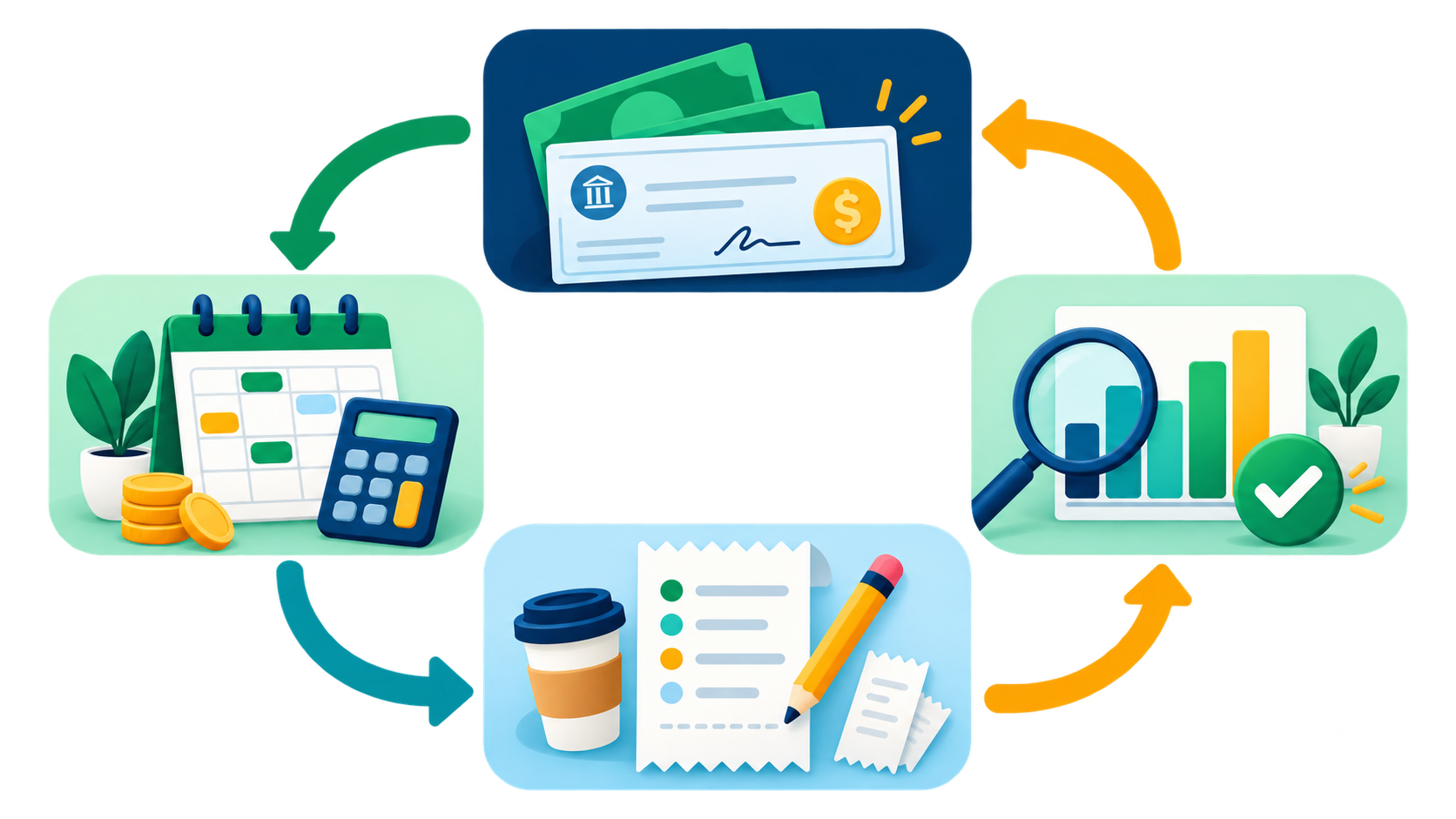
A useful budget repeats the same four-part cycle: record income, plan, track, and review.
7 Monthly Budget Templates to Consider
1. Simple income-and-expense template
List all income, then subtract fixed expenses, variable expenses, and savings. This is the easiest starting point for beginners or anyone who wants a fast monthly overview.
2. Zero-based budget template
Assign every expected dollar to a bill, spending category, savings goal, or buffer until planned income minus planned allocations equals zero. “Zero” means every dollar has a job, not that your bank balance should be zero.
3. Paycheck budget template
Organize bills and goals around each payday rather than one monthly total. This can be helpful when due dates cluster unevenly or cash timing matters more than the monthly total.
4. 50/30/20 planning template
Use broad buckets for needs, wants, and savings or debt goals. The percentages are guidelines, not universal rules; housing costs, income, family needs, and local prices may require a different split.
5. Variable-income template
Build the plan around conservative baseline income, then create priorities for extra income. Include a separate buffer for taxes when you are self-employed and seek tax guidance when your situation is complex.
6. Sinking-fund template
Add lines for expenses that are predictable but not monthly—car repairs, annual insurance, gifts, travel, or school costs. Divide the expected amount by the months remaining to create a monthly target.
7. Couples or household template
Combine shared income and expenses while keeping agreed personal categories visible. The practical benefit is a common view of due dates, responsibilities, and goals—not one mandatory way to merge finances.
Quick Comparison: Which Template Fits?
| Template | Useful when | Main tradeoff |
|---|---|---|
| Simple | You want a low-effort overview | Less detail for timing and irregular costs |
| Zero-based | You want every dollar assigned | Requires more frequent updates |
| Paycheck | Cash-flow timing is tight | Can feel repetitive with many pay periods |
| 50/30/20 | You prefer broad guardrails | Fixed percentages may not match your reality |
| Variable income | Income changes from month to month | Needs conservative estimates and a buffer |
| Sinking fund | Irregular bills disrupt the budget | Adds more categories to maintain |
| Household | Multiple people share costs and goals | Requires clear agreements and regular check-ins |
How to Use a Monthly Budget Template
Step 1: Gather real numbers
Collect recent pay stubs, bank and credit-card statements, bills, and receipts. Use net income—the amount you can actually spend. For uneven income, Consumer.gov suggests using prior-year income divided by 12 as one way to estimate a monthly amount; a more conservative baseline may be appropriate if income is volatile.
Step 2: Separate fixed, variable, and irregular costs
Start with obligations, then estimate flexible categories from recent transactions. Finally, scan the calendar for nonmonthly costs. A budget can look balanced and still fail if an annual fee or car repair is missing.
Step 3: Add savings as a planned line
Instead of waiting to see what remains, add a realistic savings amount to the plan. A small repeatable amount is often more useful than an aggressive target that forces repeated transfers back to checking.
Step 4: Track spending during the month
Update actual spending weekly, or more often if cash is tight. The Consumer Financial Protection Bureau provides spending trackers and a bill calendar in its Your Money, Your Goals toolkit. Tracking is what turns a static template into useful feedback.
Step 5: Close the month and adjust
Compare planned and actual totals. Identify one or two categories with the largest difference, then change the next budget. A budget is an estimate that improves with evidence; it is not a test you pass or fail.
Example Monthly Budget
Assume a household has $4,800 in monthly take-home pay. The following example is illustrative and does not prescribe a universal allocation:
| Category | Planned amount | Share of income |
|---|---|---|
| Housing and utilities | $1,750 | 36.5% |
| Food | $650 | 13.5% |
| Transportation | $500 | 10.4% |
| Insurance and healthcare | $400 | 8.3% |
| Debt minimums | $350 | 7.3% |
| Savings and sinking funds | $650 | 13.5% |
| Personal and entertainment | $350 | 7.3% |
| Buffer | $150 | 3.1% |
| Total | $4,800 | 100% |
The right numbers may look very different. The useful feature is that the total matches expected take-home pay and includes both a goal category and a modest buffer.
Monthly Budget Templates: Common Mistakes
- Using gross pay: base spending decisions on money available after payroll deductions.
- Forgetting irregular expenses: review the full year for renewals, maintenance, holidays, and seasonal bills.
- Making categories too strict: leave a small buffer so one surprise does not invalidate the whole plan.
- Tracking without reviewing: data only helps when it changes the next decision.
- Choosing too much detail: if 40 categories stop you from updating the template, combine them.
- Treating guidelines as rules: popular percentages are starting points, not requirements.
Bottom Line
Pick one of these monthly budget templates, enter real numbers, and test it for one full month. Keep what helps, remove what creates friction, and let each month’s actual spending improve the next plan.
Frequently Asked Questions
What is the best monthly budget template for beginners?
A simple income-and-expense template is usually easiest. Start with take-home pay, essential bills, flexible spending, savings, and a planned-versus-actual column.
Should I use a spreadsheet, app, or printable budget?
Use the format you will update consistently. Spreadsheets automate totals, apps may import transactions, and printable templates can reduce complexity and screen time.
How often should I update my monthly budget?
Plan before the month begins, check progress at least weekly, and complete a month-end review. More frequent updates may help when income varies or cash flow is tight.
How do I budget with irregular income?
Use a conservative baseline, rank expenses by priority, and decide in advance how extra income will be allocated. Keep tax obligations separate when applicable.
What if my expenses are higher than my income?
Verify the numbers, protect essentials, and look for categories or due dates you can change. If debt or missed bills are becoming unmanageable, consider a reputable nonprofit credit counselor or appropriate professional help.
References
- Making a Budget — Consumer.gov, Federal Trade Commission.
- Your Money, Your Goals toolkit — Consumer Financial Protection Bureau.
- Analyze Your Spending Tracker — Consumer Financial Protection Bureau.
- Money Smart Financial Education Program — Federal Deposit Insurance Corporation.