
50/30/20 Budget: A Simple Guide With Real Examples
50/30/20 Budget: A Simple Framework for Your Money
The 50/30/20 budget divides monthly after-tax income into three broad categories: 50% for needs, 30% for wants, and 20% for savings and debt goals. It is a flexible starting point—not a financial law—and the percentages can be adjusted when housing, health care, family responsibilities, or debt payments make the standard split unrealistic.

The three-part framework gives every dollar a broad job while keeping the plan easy to review.
What is the 50/30/20 budget?
The rule is a percentage-based budgeting method built around net—or take-home—income. The Consumer Financial Protection Bureau describes a version that assigns 50% of monthly net income to needs, 30% to wants, and 20% to savings goals. Another CFPB worksheet describes the final category as savings and debt payments. Both versions use the framework as a rule of thumb rather than a mandatory standard.
Essential expenses required for basic living, work, health, and minimum contractual obligations.
Optional or flexible spending that improves comfort or enjoyment but can usually be reduced.
Emergency savings, other financial goals, retirement contributions, and debt payments above required minimums.
The framework is intentionally broad. It helps households see whether essentials are consuming most of their take-home pay and whether future goals have a regular place in the budget. If you need a detailed worksheet before grouping expenses, start with our monthly budget templates.
How to calculate a 50/30/20 budget
- Find monthly take-home pay. Use the amount deposited after payroll taxes and other paycheck deductions. If income varies, average several representative months or use annual net income divided by 12.
- Calculate the targets. Multiply take-home pay by 50%, 30%, and 20%.
- Classify actual transactions. Review statements and place each expense in the most reasonable category.
- Compare targets with reality. Look for the categories that exceed the guideline.
- Adjust the plan. Change spending, the timeline for a goal, or the percentages when necessary.
Example with $4,000 in monthly take-home pay
| Category | Calculation | Monthly target | Possible uses |
|---|---|---|---|
| Needs | $4,000 × 0.50 | $2,000 | Housing, basic utilities, groceries, transportation, insurance, minimum debt payments |
| Wants | $4,000 × 0.30 | $1,200 | Dining out, entertainment, hobbies, upgrades, optional travel |
| Savings and debt goals | $4,000 × 0.20 | $800 | Emergency fund, retirement, planned purchases, extra principal payments |
This example is educational, not a universal recommendation. A household with high rent and child care may need more than 50% for essentials, while someone with low fixed costs may choose to direct more than 20% toward goals.
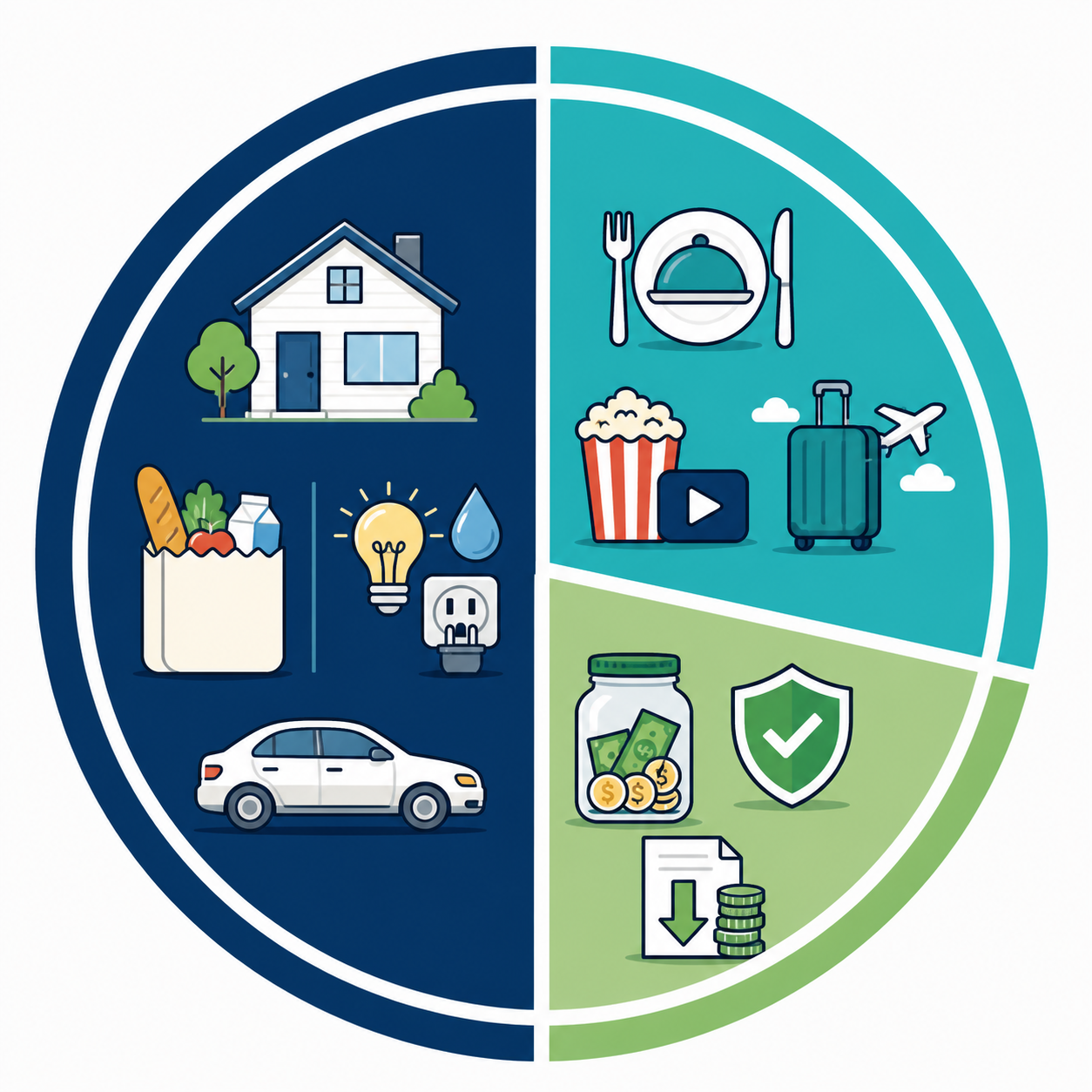
Needs take the largest share, followed by flexible wants and savings or debt goals.
What counts as needs?
Needs are costs that generally cannot be skipped without affecting housing, health, safety, employment, or contractual obligations. Common examples include:
- Rent or mortgage payments
- Basic electricity, water, heating, and phone service
- Necessary groceries and household supplies
- Transportation required for work and essential activities
- Insurance premiums and essential medical costs
- Child care required to work
- Minimum required debt payments
A need can still include choices. Housing is essential, but a particular apartment size or neighborhood may include a discretionary component. Classification is less important than using one consistent method month after month.
What counts as wants?
Wants are expenses that can usually be postponed, reduced, or replaced without disrupting basic living. Examples may include restaurant meals, premium subscriptions, entertainment, elective upgrades, nonessential shopping, and leisure travel.
The wants category is not a list of “bad” purchases. It gives flexible spending a deliberate limit so the budget remains livable. Some expenses cross categories: a basic phone plan may be a need, while the cost of an upgraded device or premium plan may be a want.
What belongs in the 20% category?
The final portion supports future financial security. Depending on the version used, it can include savings goals and debt payments above minimums. Possible priorities are:
- A starter cash buffer and a larger emergency fund
- Sinking funds for predictable annual expenses
- Workplace retirement contributions and employer-match opportunities
- IRA contributions when eligible
- Extra payments toward credit cards, student loans, or other debt
- Medium-term goals such as education, a move, or a home down payment
Account rules and contribution limits can change. The IRS reports that the basic employee deferral limit for many 401(k) plans is $24,500 for 2026, while the combined Traditional and Roth IRA contribution limit is $7,500 for 2026, subject to compensation and eligibility rules. Always verify current limits and plan terms before contributing.
How to adapt the 50/30/20 rule
A budget that works in a lower-cost area may fail in a city where rent takes half of take-home pay. Instead of treating the percentages as a pass-or-fail test, use them as a diagnostic benchmark.
| Situation | Possible temporary split | Practical response |
|---|---|---|
| High housing or child-care costs | 60/20/20 | Protect essential bills and savings while limiting flexible spending. |
| Aggressive debt payoff | 50/20/30 | Direct more toward goals while maintaining a sustainable wants category. |
| Unstable income | 60/20/20 | Budget from a conservative income estimate and build a larger cash buffer. |
| Low fixed costs | 40/30/30 | Use extra capacity for retirement, investing, or other defined goals. |
These alternatives are examples, not prescriptions. Taxes, benefits, health needs, debt terms, dependents, and local costs can materially change an appropriate plan.
Steps when needs exceed 50%
- Confirm that take-home income and all recurring costs are accurate.
- Separate essential costs from optional upgrades inside the same bill.
- Review housing, transportation, insurance, utilities, and debt—the largest items usually matter most.
- Protect minimum payments and basic insurance coverage before cutting.
- Set a realistic temporary ratio and a date to review it.
Consumer.gov recommends listing bills and expenses, subtracting them from monthly income, and revisiting the plan each month. Our saving money guide offers practical ideas for recurring expenses and automatic transfers.
Advantages and limitations
- Easy to calculate
- Balances today’s spending with future goals
- Works without tracking dozens of categories
- Provides a useful benchmark
- Does not reflect every local cost
- Classification can be subjective
- May not suit very high or irregular debt payments
- Does not replace detailed retirement or tax planning
50/30/20 budget checklist
- Calculate average monthly take-home pay.
- List actual expenses from recent statements.
- Classify needs, wants, and savings or debt goals consistently.
- Compare actual percentages with the guideline.
- Automate a manageable savings transfer.
- Review the plan monthly and after major income or expense changes.
Frequently asked questions
Is the 50/30/20 budget based on gross or net income?
It is generally based on monthly net or take-home income. Be consistent about how you treat payroll deductions, especially retirement and health benefits.
Do minimum debt payments count as needs?
Required minimum payments are commonly treated as needs because they are contractual obligations. Payments above the minimum can fit in the 20% savings and debt-goal category.
Do 401(k) contributions count toward the 20%?
They can. If contributions are deducted before take-home pay reaches your bank account, add them back when measuring total goal contributions or clearly document a consistent alternative method.
What if my needs are more than 50%?
Use the percentages as a benchmark, not a reason to ignore essential bills. Set a realistic temporary ratio, review major fixed costs, and work toward a sustainable balance over time.
Is the 50/30/20 rule suitable for variable income?
It can be adapted by using a conservative monthly income estimate, budgeting essential costs first, and keeping a cash buffer for lower-income months.
References
- Consumer Financial Protection Bureau — Analyzing Budgets
- Consumer Financial Protection Bureau — 50-30-20 Budget Worksheet
- Consumer.gov — Making a Budget
- Internal Revenue Service — Retirement Topics: Contributions
- Internal Revenue Service — IRA Contribution Limits
Important: This article is for general informational and educational purposes only and is not financial, investment, tax, or legal advice. Budget percentages, account eligibility, contribution limits, fees, and tax treatment vary by household and can change. Verify current information with official sources and consider a qualified professional for guidance tailored to your situation.