
Saving Money: 12 Practical Ways to Save More in 2026
Saving Money Strategies That Work
Saving money works best when it is a repeatable system, not a one-time spending freeze. Start with one clear goal, create room in your budget, automate a manageable transfer, and review the plan each month. Small, consistent actions can make everyday expenses easier to handle while moving you toward larger financial goals.

A simple saving system connects everyday choices with specific financial goals.
Why saving money matters
Saving money creates options. Cash set aside can help cover an unexpected car repair, reduce reliance on high-interest debt, fund a planned purchase, or support a future move. The purpose is not to maximize every dollar at the expense of daily life. It is to give future expenses a place in today’s plan.
A written budget makes that tradeoff visible. Consumer.gov explains that a budget can help people avoid running out of money and save for goals or emergencies. If income minus expenses leaves a positive amount, assigning part of it to savings turns an intention into a decision.
Set goals before cutting expenses
Vague goals are difficult to fund. Name the goal, choose a target amount, set a date, and divide the amount by the number of months available.
Upcoming bills, annual insurance premiums, travel, or a small cash buffer.
A vehicle, education costs, a move, or a larger emergency reserve.
Retirement or goals several years away, where investment risk and time horizon matter.
Keep separate goals distinct. Money needed soon usually belongs in an accessible, low-risk account; long-term investing involves market risk and should match your circumstances. For cash storage options, see our guide to high-yield savings accounts.
12 practical ways to save money
1. Track one full month of spending
Review bank and credit card statements and group purchases into housing, transportation, food, health, debt payments, subscriptions, and flexible spending. Use actual transactions rather than estimates. A monthly budget template can make the pattern easier to see.
2. Pay savings automatically
Schedule a recurring transfer from checking to savings or split direct deposit between accounts if your employer allows it. The Consumer Financial Protection Bureau notes that automatic transfers can make saving consistent, but recommends monitoring balances, timing, and possible fees so the transfer does not cause an overdraft.
3. Start with an amount you can sustain
A modest transfer that continues for a year can be more useful than an aggressive target canceled after two paychecks. Increase the amount after a raise, a paid-off bill, or a successful monthly review.
4. Build a starter emergency buffer
Unexpected expenses are easier to absorb when cash is available. Choose an initial milestone that fits your budget, then build from there. The right amount depends on income stability, household needs, insurance, debt, and other circumstances. Our emergency funds guide explains how to structure this reserve.
5. Use sinking funds for predictable costs
Car registration, holidays, school costs, and annual subscriptions are not emergencies. Estimate the yearly amount and save one-twelfth each month in a dedicated category or subaccount.
6. Audit recurring charges
Review subscriptions, memberships, software, storage plans, and insurance renewals. Cancel services you no longer use, downgrade those that exceed your needs, and compare alternatives before renewal. Check cancellation terms and replacement coverage before changing essential services.
7. Add a waiting period to optional purchases
For nonessential purchases, wait 24 hours—or longer for expensive items. Keep the item on a list and revisit it. The delay creates space to compare prices, check the budget, and decide whether the purchase still supports your priorities.
8. Plan food before shopping
Check what you already have, plan several flexible meals, make a list, and compare unit prices. A realistic plan should leave room for convenience; a perfect menu that goes unused does not save money.
9. Capture windfalls intentionally
Tax refunds, bonuses, gifts, and rebates can accelerate a goal. Decide in advance how much will go to savings, debt, and current spending. CFPB suggests using one-time opportunities as one way to build emergency savings, while recognizing that individual priorities differ.
10. Lower a large expense carefully
Housing, transportation, insurance, and debt costs often offer more potential than small daily purchases, but changes can carry tradeoffs. Compare total costs, fees, coverage, commute time, and contract terms before switching.
11. Send paid-off payments to savings
When a loan or installment ends, redirect some or all of the former payment before lifestyle costs expand. This preserves a cash flow habit without requiring a new cut elsewhere.
12. Review and adjust monthly
Compare the amount planned with the amount actually saved. If the target repeatedly fails, change the amount or timeline instead of abandoning the system. A workable plan should adapt to real life.
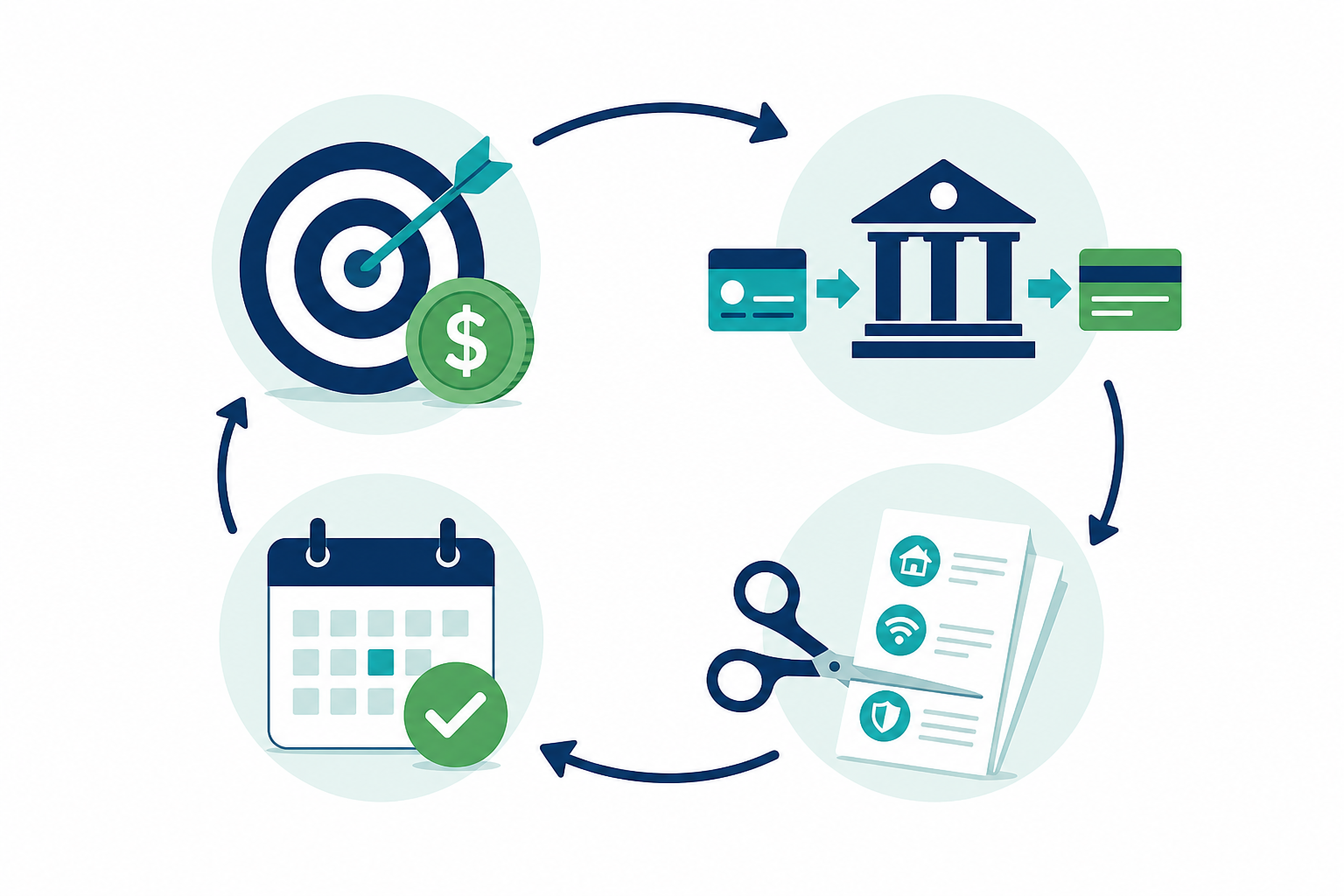
The cycle: set a goal, automate progress, trim low-value costs, and review the result.
Choose the right place for savings
| Goal | Useful features | What to check |
|---|---|---|
| Emergency fund | Easy access, low volatility, separation from daily spending | Deposit insurance eligibility, withdrawal rules, fees |
| Planned expense | Goal buckets, automatic transfers, predictable value | Timing, minimum balance, transfer limits |
| Long-term goal | Potential growth appropriate to the time horizon | Risk, diversification, taxes, fees, account rules |
For bank deposits, verify whether the institution and account are eligible for FDIC or NCUA coverage and understand applicable limits. Investment accounts are different: their value can fluctuate, and securities are not the same as insured bank deposits.
How small savings can grow
Consistency matters partly because of compounding. Investor.gov describes compound interest as interest earned on principal plus interest accumulated earlier. A hypothetical $100 monthly contribution over several years may grow from both contributions and returns, but actual investment returns are not guaranteed and savings-account yields can change.
Use the official Investor.gov compound interest calculator to explore assumptions. Treat projections as illustrations, not promises.
Common saving mistakes to avoid
- Saving without a cash-flow check: an automatic transfer that triggers overdraft fees can erase progress.
- Using emergency money for predictable bills: sinking funds help separate the two.
- Ignoring high-cost debt: saving and debt repayment priorities depend on rates, liquidity needs, and risk.
- Chasing promotional yields: compare ongoing rates, fees, requirements, and access—not just the headline offer.
- Making the plan too strict: a budget needs room for irregular expenses and reasonable enjoyment.
Saving money checklist
- Name one specific savings goal and deadline.
- Review a month of transactions.
- Choose a manageable payday transfer.
- Keep emergency savings accessible.
- Review subscriptions and one large expense.
- Track progress once a month and adjust.
Frequently asked questions
What is the best way to start saving money?
Start with a specific goal and a small automatic transfer that fits your current cash flow. Track one month of spending, then adjust the amount using real numbers.
How much money should I save each month?
There is no universal percentage. A suitable amount depends on income, essential expenses, debt, job stability, dependents, and goals. Choose an amount you can sustain and review it regularly.
Should I save money or pay off debt first?
Many households balance a starter emergency buffer with repayment of high-cost debt. The best order depends on interest rates, minimum payments, liquidity, employer benefits, and personal risk. Consider professional financial guidance for a tailored plan.
Where should I keep emergency savings?
Emergency savings are generally most useful when accessible, stable, and separate from everyday spending. Compare insured bank or credit-union accounts, fees, withdrawal rules, and transfer speed.
How can I stay motivated while saving?
Use named goals, automate contributions, display progress, celebrate milestones within the budget, and revise targets when circumstances change.
References
- Consumer.gov — Making a Budget
- Consumer Financial Protection Bureau — Looking for an Easy Way to Save Money? Make It Automatic
- Consumer Financial Protection Bureau — An Essential Guide to Building an Emergency Fund
- Investor.gov — Small Savings Add Up to Big Money
Important: This content is for general informational and educational purposes only and is not financial, investment, tax, or legal advice. Financial products, rates, fees, tax treatment, and eligibility rules can change. Consider your circumstances, verify current terms with official sources and product disclosures, and consult a qualified professional when appropriate.