
Emergency Funds: A Practical Guide to Building Your Safety Net
Emergency funds are dedicated cash reserves for unexpected essential expenses and income interruptions.
Emergency Funds: A Practical Guide to Building Your Safety Net
Emergency funds are cash reserves set aside for unplanned expenses or a sudden loss of income. This guide explains how to choose a realistic target, where to keep the money, and how to build your fund without relying on a one-size-fits-all rule.

Key Takeaways
- Start with a reachable milestone, then work toward a reserve based on your essential expenses and income stability.
- Keep emergency savings safe, accessible, and separate from money used for routine spending.
- Automated transfers, windfalls, and redirected debt payments can help build the fund consistently.
- Use the money for genuine, necessary, and unplanned costs—then rebuild after a withdrawal.
Emergency funds can reduce the need to put an unexpected car repair, medical bill, or temporary income gap on a high-interest credit card. They are not designed to maximize investment returns. Their main job is to provide dependable cash when normal monthly plans are disrupted.
The Consumer Financial Protection Bureau notes that even a small amount can provide financial security. That matters because a large target can feel discouraging at the start. A better approach is to build emergency savings in stages and revise the goal as your circumstances change.
What Emergency Funds Are—and Are Not
An emergency fund is a dedicated cash reserve for necessary expenses you did not reasonably include in the monthly budget. Common examples include:
- urgent car or home repairs;
- an insurance deductible or unexpected medical cost;
- a job loss, reduced hours, or delayed freelance payment;
- essential travel during a family emergency; or
- replacing a critical appliance or device.
It is different from a sinking fund. A sinking fund covers a cost you know is coming, such as annual insurance, holiday spending, or scheduled maintenance. It is also different from retirement savings, which generally has a long time horizon and may involve taxes, penalties, or market risk when accessed early.
If routine bills repeatedly feel like emergencies, revisit your monthly budget. The issue may be a missing category, irregular income, or due dates that do not match your cash flow.
How Much Should You Keep in an Emergency Fund?
There is no universal amount. The CFPB says the appropriate target depends on your situation. The FDIC reports that financial experts generally recommend at least six months of living expenses, but that broad benchmark may be too large for a first goal and may not fit every household.
Stage 1: Starter cushion
Choose a concrete first milestone—perhaps enough to cover your most common unexpected bill or insurance deductible. The purpose is to create useful protection quickly.
Stage 2: One month of essentials
Add housing, basic utilities, groceries, insurance, transportation, minimum debt payments, healthcare, and necessary childcare for one month.
Stage 3: Expanded reserve
Work toward several months of essential expenses based on job stability, household earners, health needs, dependents, insurance coverage, and access to other support.
Review annually
Recalculate after a move, job change, new dependent, major debt payoff, or significant increase in essential costs.
Emergency fund target = monthly essential expenses × target number of months
For example, assume essential expenses total $3,200 per month. A one-month reserve is $3,200, three months is $9,600, and six months is $19,200. Those figures are planning examples, not required amounts.
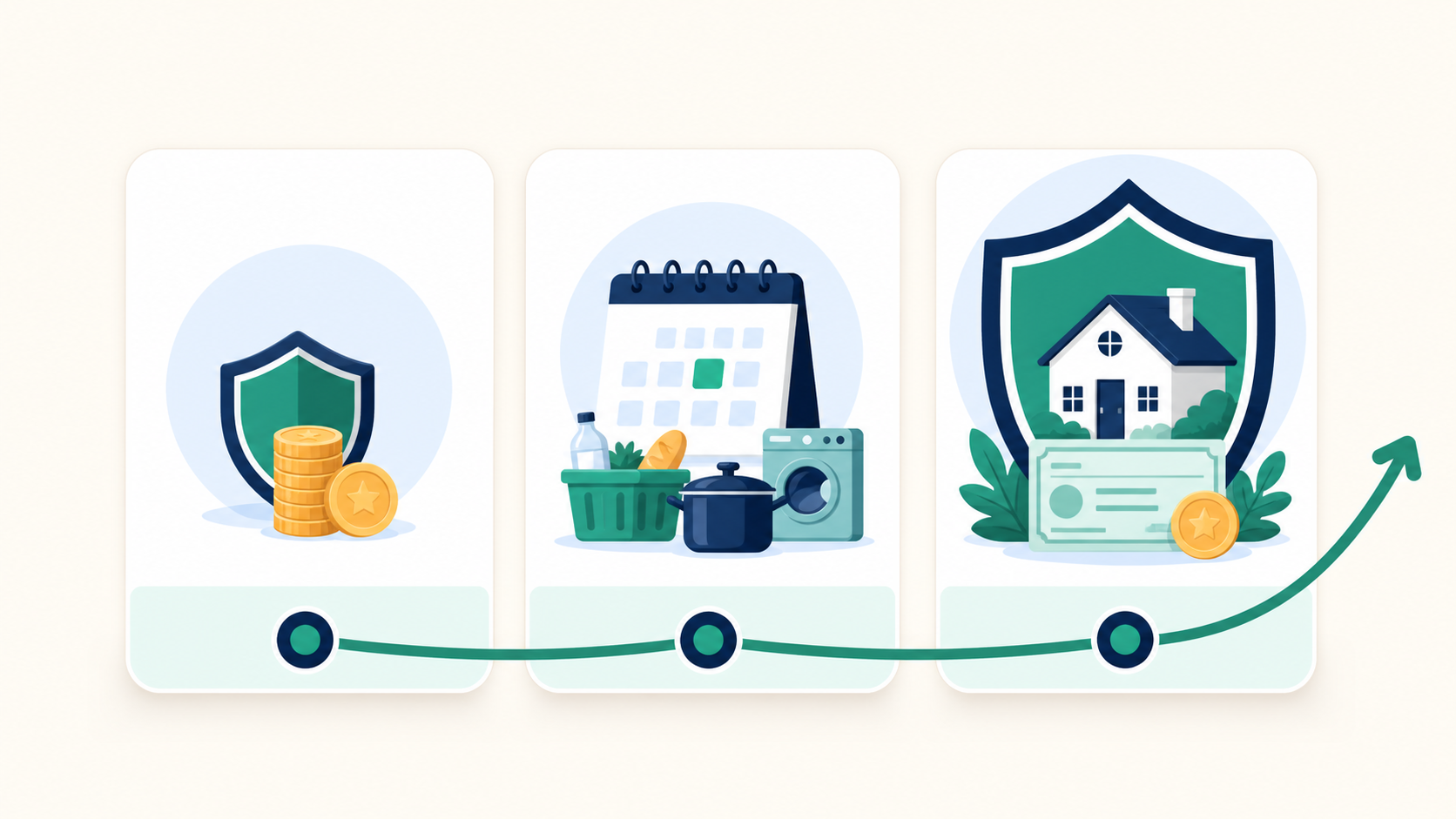
Build in stages: a starter cushion, one month of essentials, and then a larger reserve that reflects your risks.
Factors That May Affect Your Target
| Factor | A larger reserve may help when | A smaller initial target may be practical when |
|---|---|---|
| Income | Pay varies or work is seasonal | Income is stable and predictable |
| Household | One income supports several people | Multiple stable incomes share essential costs |
| Health and insurance | Deductibles or recurring risks are high | Coverage and out-of-pocket exposure are lower |
| Home and transportation | You own an older home or essential vehicle | Maintenance exposure is limited |
| Support and flexibility | Backup resources are limited | You have reliable support or flexible expenses |
These factors do not create a precise formula. They help you choose a target that reflects the consequences of an income interruption or urgent bill. A realistic plan can include more than one milestone instead of one intimidating final number.
Where Should Emergency Funds Be Kept?
Emergency savings should generally be safe, liquid, and easy to reach without being so convenient that you spend it casually. Common options include:
- Dedicated savings account: separation from checking can reduce accidental spending while preserving access.
- High-yield savings account: may pay a competitive annual percentage yield, but rates and account terms can change. Compare access, fees, minimums, and transfer times—not APY alone. See our guide to high-yield savings accounts.
- Money market deposit account: can offer savings features with limited transaction access; terms vary by institution.
- Small amount of physical cash: may be useful during a power outage or disaster, but cash can be lost, stolen, or destroyed. The FDIC advises keeping no more at home than needed for immediate needs.
At an FDIC-insured bank, eligible deposits are insured to applicable limits. Federally insured credit unions provide similar coverage through the National Credit Union Share Insurance Fund. Confirm the institution and ownership category rather than assuming every financial product is insured.
Stocks, bond funds, and other market investments can lose value when you need the money. Certificates of deposit may charge an early-withdrawal penalty. These tradeoffs can make them less suitable for the most immediately accessible portion of emergency savings.
How to Build Emergency Funds Step by Step
- Set the first milestone. Choose a specific amount connected to a plausible expense rather than waiting until you can fund several months at once.
- Open or designate a separate account. Confirm fees, minimum balances, transfer timing, withdrawal access, and deposit insurance.
- Automate a sustainable amount. Schedule a transfer after each payday. The FDIC illustrates that $20 saved every other week adds up to $520 in a year, before interest.
- Use windfalls intentionally. Consider directing part of a tax refund, bonus, gift, or sale proceeds to the fund.
- Redirect finished payments. After paying off a loan, move some or all of the old payment amount into savings.
- Track progress monthly. Celebrate milestones and increase the transfer when income or expenses allow.
When Should You Use the Money?
Create a short rule before the emergency happens. Ask whether the expense is necessary, urgent, and genuinely unplanned. A broken furnace during winter may qualify; a predictable annual membership renewal usually belongs in the regular budget.
Using the fund for a legitimate emergency is not failure. It is the purpose of the account. Afterward, update the budget and restart automatic contributions. If the same type of cost repeats, create a sinking fund so it becomes a planned expense.
Emergency Funds: Common Mistakes
- Waiting for the “perfect” amount before saving anything.
- Using gross income instead of essential expenses to set the target.
- Keeping the entire reserve in an account with fees, delays, or withdrawal penalties you did not review.
- Investing near-term emergency money in volatile assets.
- Treating predictable costs as emergencies rather than budgeting for them.
- Failing to rebuild after a withdrawal.
Bottom Line
Emergency funds work best when the target is personal, the money is accessible, and saving is automatic. Start with a useful first milestone, protect it from routine spending, and expand the reserve over time.
Frequently Asked Questions
How much should I have in an emergency fund?
Base the target on essential expenses, income stability, dependents, insurance, and likely risks. Begin with a reachable milestone and build toward several months if appropriate.
Where is the best place to keep emergency savings?
A separate, federally insured savings account is a common option because it can balance safety and access. Compare fees, minimums, transfer times, and withdrawal rules.
Should I build an emergency fund or pay off debt first?
A starter cushion may reduce new borrowing when surprises occur, while high-cost debt also deserves attention. The right balance depends on interest costs, minimum payments, income stability, and available cash.
Can I invest my emergency fund?
Money needed on short notice generally should not depend on market prices. Investments can fall in value, so they may not fit the immediately accessible portion of the fund.
What counts as a financial emergency?
A useful test is whether the expense is necessary, urgent, and unplanned. Create your rules in advance and use sinking funds for predictable nonmonthly costs.
References
- An Essential Guide to Building an Emergency Fund — Consumer Financial Protection Bureau.
- Saving for the Unexpected and Your Future — Federal Deposit Insurance Corporation, January 2025.
- Natural Disaster Impact: Advice for Consumers — Federal Deposit Insurance Corporation.
- Making a Budget — Consumer.gov, Federal Trade Commission.