
Credit Score Factors: What Affects Your Score Most?
Credit score factors are the pieces of information in your credit reports that scoring models evaluate to estimate how likely you are to repay borrowed money. Understanding them can help you focus on habits that matter—without chasing myths or quick fixes.

- Payment history is generally the largest factor in widely used FICO scoring models.
- Amounts owed—including credit utilization—are also highly influential.
- Credit age, recent applications, and account mix matter, but carry smaller typical weights.
- There is no single universal credit score; models, bureau data, and calculation dates can produce different results.
- No legitimate strategy can guarantee a particular score increase or timeline.
What Is a Credit Score?
A credit score is a prediction based on information in a credit report. Lenders may use it, along with income, debt, collateral, and their own underwriting rules, when deciding whether to offer credit and on what terms. Most familiar consumer scores run from 300 to 850, but the number you see can vary.
That variation is normal. You may have reports at Equifax, Experian, and TransUnion, and the information may not be identical at each bureau. FICO and VantageScore also offer multiple model versions designed for different lending uses. A score from one app therefore may not match the score a mortgage, auto, or card lender obtains.
If you are new to scoring, our guides to FICO scores, VantageScore, and credit score ranges provide useful context.
The Five Major FICO Credit Score Factors
FICO publishes five broad categories and typical weights for its general scoring model. These percentages are educational guideposts—not a formula you can use to predict an exact point change. The importance of any item depends on the rest of a person’s credit profile.
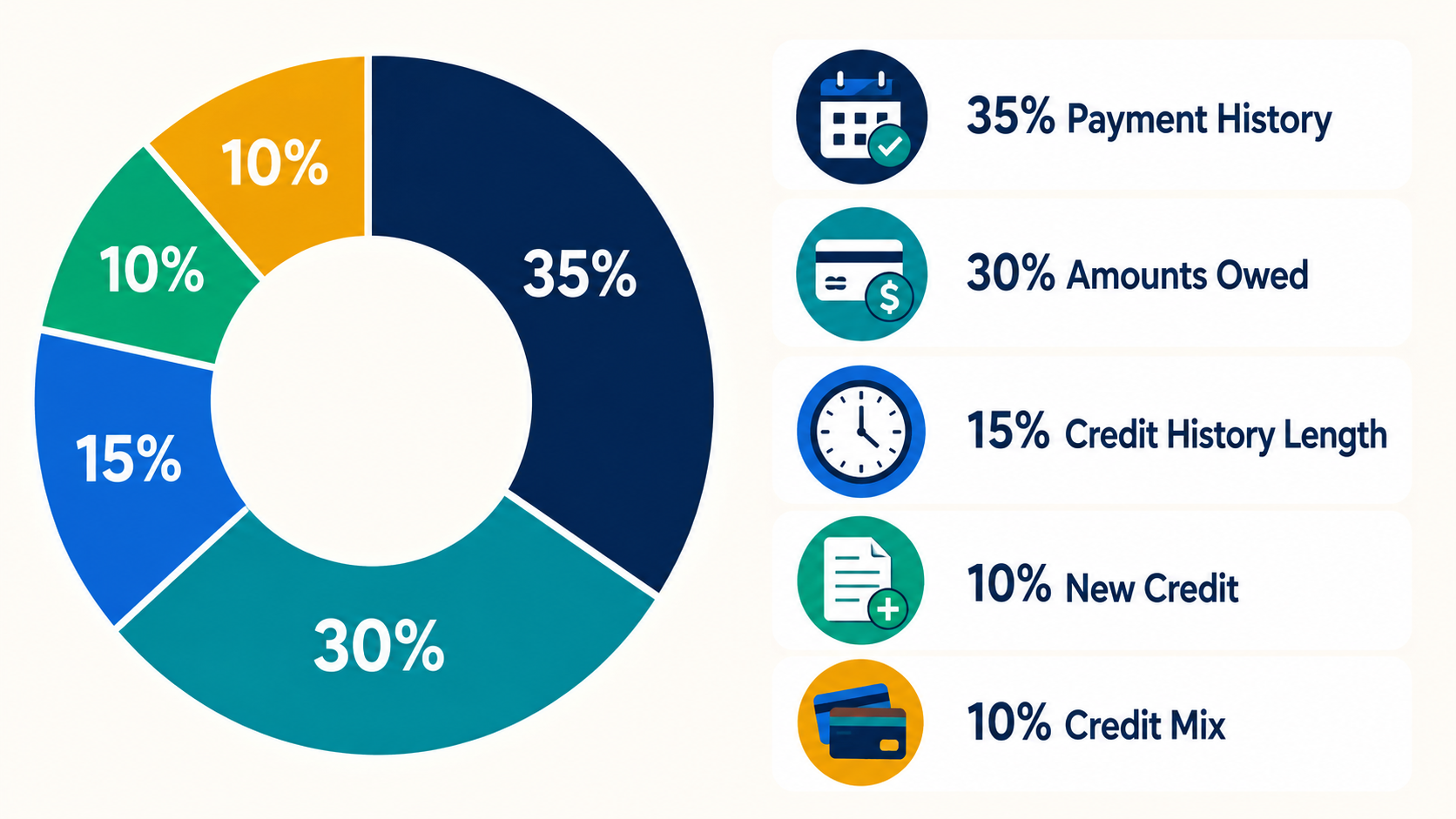
| Factor | Typical FICO weight | What it may include | Practical focus |
|---|---|---|---|
| Payment history | 35% | On-time and late payments, collections, and major derogatory events | Pay every account by its due date |
| Amounts owed | 30% | Total balances, revolving utilization, and balances across account types | Keep card balances manageable relative to limits |
| Credit history length | 15% | Age of oldest and newest accounts and average account age | Maintain established accounts when they still fit your needs |
| New credit | 10% | Recent hard inquiries and newly opened accounts | Apply selectively and compare offers thoughtfully |
| Credit mix | 10% | Experience with revolving and installment accounts | Do not borrow solely to diversify your file |
1. Payment History: 35%
Payment history asks a basic question: have you paid credit obligations as agreed? A missed payment can be important because it signals elevated repayment risk. Scoring models may consider how late a payment became, how recently it happened, how much was owed, and whether the pattern affected one or several accounts.
The safest approach is simple: make at least the required payment by the due date. Automatic payments for the minimum amount can create a backstop, while calendar reminders and alerts add protection. Review the account after every scheduled payment so a failed transfer does not go unnoticed.
Negative payment information can generally remain on a credit report for up to seven years, according to the Consumer Financial Protection Bureau. Its impact is not necessarily constant, and newer positive information can become part of the file over time.
2. Amounts Owed and Credit Utilization: 30%
This category looks beyond the total dollars you owe. For revolving accounts such as credit cards, a central measure is credit utilization: the reported balance divided by the credit limit. If your cards report $1,500 in combined balances and $10,000 in combined limits, overall utilization is 15%.
Models may examine utilization overall and on individual cards. A heavily used card can matter even when your total utilization looks moderate. The balance shown on your credit report is commonly the balance reported around the statement date, not necessarily what remains after a later payment.
You may hear that staying below 30% guarantees a good score. It does not. The CFPB notes that experts often advise keeping use below 30%, while scoring outcomes depend on the full file and model. In general, lower reported revolving balances tend to present less risk, but zero debt is not a requirement for a healthy score.
Paying card statement balances in full by the due date can also help you avoid interest when a grace period applies. Never carry interest-bearing debt just to try to build credit.
3. Length of Credit History: 15%
A longer track record gives a model more evidence about how you manage credit. This category can include the age of your oldest account, newest account, average account age, and how long particular accounts have been used.
Closing a card does not always remove its history immediately; an account in good standing may remain on reports for years. However, closing can reduce available revolving credit and raise utilization. Before keeping an old card, weigh any annual fee, security risk, and temptation to overspend. Account age is useful, but it should not override cost or safety.
4. New Credit: 10%
When you formally apply for credit, a lender may make a hard inquiry. Several hard inquiries and new accounts in a short period can suggest greater risk, especially for a thin or young file. Opening a new account can also lower average account age.
Checking your own report or score is a soft inquiry and does not hurt your score. Many prequalification checks are also soft, but confirm the lender’s terms before proceeding. Some scoring models group certain mortgage, auto, or student-loan rate-shopping inquiries made within a limited window, yet the window varies by model. Focused comparison shopping is preferable to scattered applications over many months.
5. Credit Mix: 10%
Credit mix refers to experience with different account types. Revolving credit includes cards and lines of credit; installment credit includes loans repaid over a set schedule. A file showing responsible management across types may provide more information than a very limited file.
Still, mix is only a small category. Taking out a loan, paying interest, or opening an account you do not need merely to change your mix can cost more than any uncertain scoring benefit. Sound borrowing decisions come first.
What Usually Is Not a Direct Scoring Factor?
Typical consumer credit scores do not directly calculate your income, employment title, bank balance, race, religion, marital status, or age. However, lenders may separately consider lawful underwriting information such as income, employment, monthly obligations, assets, or the size of a down payment. Approval decisions and credit scores are related but not identical.
How to Work on the Factors That Matter
- Protect every due date. Use autopay, reminders, and a small cash buffer where possible.
- Reduce revolving balances. Prioritize high-interest debt, avoid adding new charges, and consider paying before the statement closes if high reported utilization is an issue.
- Apply only when the product fits. Review costs, terms, and approval requirements before authorizing a hard inquiry.
- Preserve useful account history. Keep an established no-fee account open when it remains safe and manageable; do not keep a costly or risky product solely for scoring.
- Review all three reports. Use AnnualCreditReport.com, the federally authorized source for free reports, and dispute information you believe is inaccurate.
Common Credit Score Mistakes
- Missing a due date because a card was not used often.
- Maxing one card while assuming low overall utilization makes it irrelevant.
- Applying for several unrelated products in quick succession.
- Closing an old account without considering fees, utilization, and available credit.
- Paying a company that promises a guaranteed score increase or removal of accurate negative information.
- Ignoring reports because a free monitoring score looks stable.
Healthy credit is usually built through repeatable behavior rather than a one-time trick. Give accurate information time to update, and measure progress across months rather than reacting to every small fluctuation.
Frequently Asked Questions
Which credit score factor affects a score the most?
Payment history has the largest published weight—35%—in FICO’s general framework. Its actual effect varies by profile, and other models may categorize or weight information differently.
Does checking my own credit score hurt it?
No. Checking your own score or report is a soft inquiry and does not lower your score. A hard inquiry may occur when you apply for credit and authorize a lender to review your file.
Is 30% credit utilization the ideal target?
Thirty percent is a common guideline, not a guaranteed threshold or universal ideal. Lower reported revolving utilization is generally associated with less risk, but the effect depends on the model and complete credit file.
How quickly can a credit score change?
A score can change when creditors report updated balances, payments, accounts, or other information. Timing varies by creditor and bureau, and no one can promise a specific point gain within a set period.
Do income and bank balances affect credit scores?
They are not direct inputs in typical consumer credit scores. Lenders may consider income, assets, and other financial information separately when evaluating an application.
Bottom Line
The major credit score factors reward a consistent pattern: pay on time, keep revolving balances manageable, build history patiently, limit unnecessary applications, and use only credit products that support your real financial needs. Start with your credit reports, correct errors, and treat any score as one snapshot—not a measure of personal worth or a guarantee of approval.
Disclaimer: This article is for general educational purposes and is not financial, legal, tax, or credit-repair advice. Credit scoring and lending decisions vary by model, bureau, lender, and individual circumstances.
Sources
- Consumer Financial Protection Bureau: What is a credit score?
- Consumer Financial Protection Bureau: How do I get and keep a good credit score?
- Consumer Financial Protection Bureau: How long does information stay on my credit report?
- myFICO: What’s in your FICO Score?
- Federal Trade Commission: Free credit reports