
Credit Score Myths: 12 Common Claims Fact-Checked
Credit score myths can encourage costly choices—from carrying interest-bearing balances to paying a company that promises an instant fix. Here are the facts behind 12 persistent claims, based on guidance from U.S. consumer agencies and FICO.

- Checking your own credit report or score does not lower it.
- You do not need to carry a balance or pay interest to build credit.
- Closing a card can sometimes raise utilization and work against your goal.
- Income is not a direct input in typical consumer credit scores, though lenders may consider it separately.
- No legitimate credit-repair company can erase accurate, current negative information on demand.
Why Credit Score Myths Persist
Credit scoring is complicated. Consumers may see different numbers because lenders use different models, versions, bureau data, and calculation dates. Small score movements can also occur when a card issuer reports a new balance. When cause and effect are unclear, a convenient explanation can spread faster than a careful one.
A credit score predicts risk from information in a credit report; it does not measure personal worth and does not decide an application by itself. For the underlying framework, see our guide to credit score factors and our explanations of FICO scores and VantageScore.
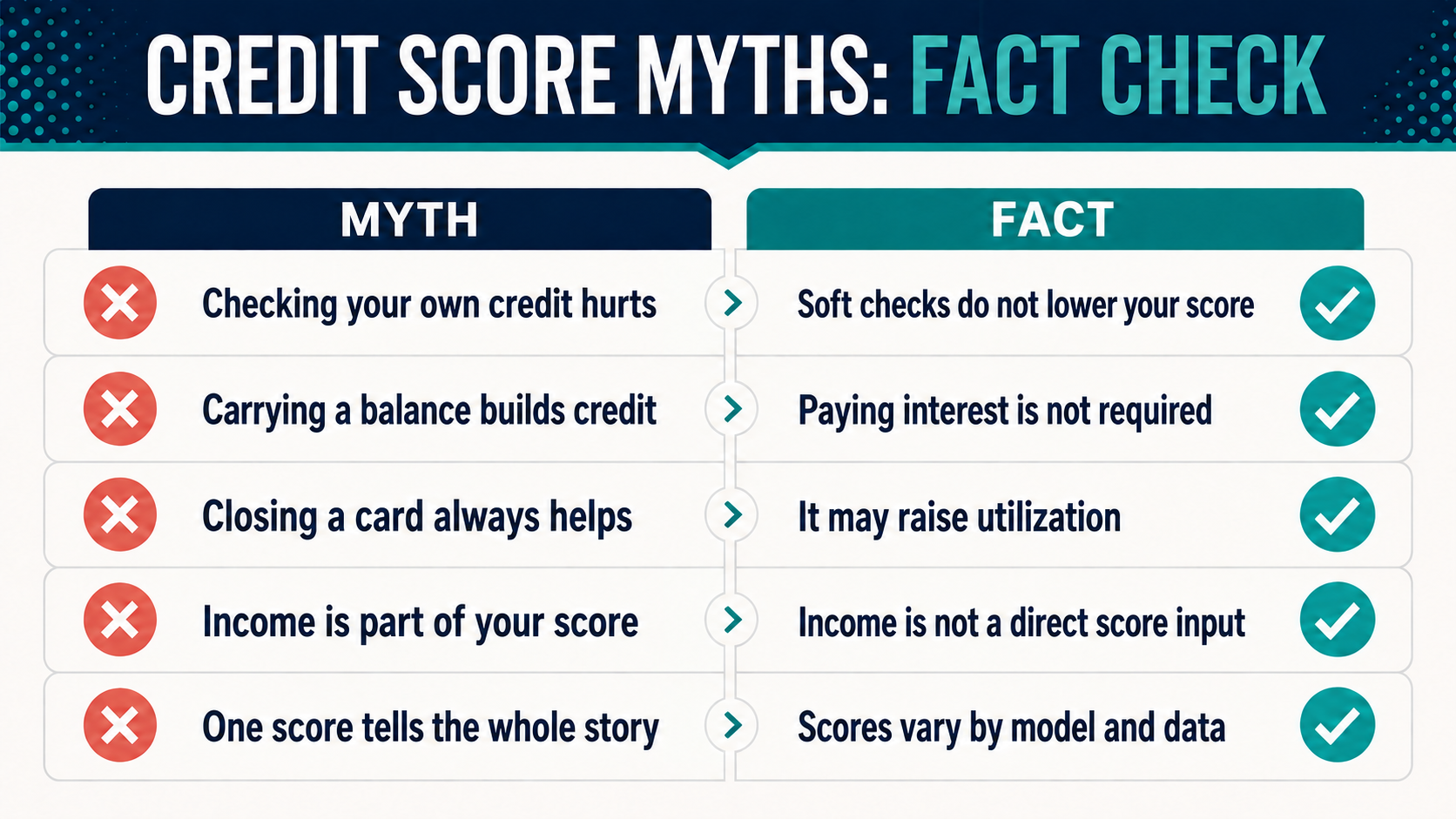
Credit Score Myths at a Glance
| Common myth | What the evidence says |
|---|---|
| Checking your own credit hurts | A self-check is a soft inquiry and does not lower your score. |
| Carrying a balance builds credit | Paying interest is unnecessary; on-time payment and reported usage matter. |
| Closing a card always helps | It may reduce available credit and increase utilization. |
| Income is part of the score | Typical scores do not directly use income, though lenders may. |
| One score tells the whole story | Scores vary by model, data source, version, and date. |
Checking Your Own Credit Hurts Your Score
Fact: Reviewing your own report or score is a soft inquiry, not an application for new credit. The Consumer Financial Protection Bureau says requesting your own credit report has no effect on your score. Regular checks can help you spot inaccurate accounts or signs of identity theft.
Use AnnualCreditReport.com, the federally authorized source for reports from Equifax, Experian, and TransUnion. A lender’s review after you apply is different and may be recorded as a hard inquiry.
Everyone Has One Universal Credit Score
Fact: A person can have many credit scores. FICO and VantageScore offer multiple versions, and specialized models may be used for mortgages, auto loans, or cards. Each score also depends on the bureau information available on the calculation date.
A free monitoring score is useful for tracking direction, but it may not match the number a lender uses. Compare like with like—same model, bureau, and date—before treating a difference as an error. Our credit score ranges guide explains how broad labels should be interpreted.
Your Income Directly Determines Your Credit Score
Fact: Income, job title, and bank balance are not direct inputs in typical consumer scores. Scores are calculated from credit-report data such as payment history, balances, account age, recent applications, and account types.
A lender can still consider income, employment, assets, monthly debt, or debt-to-income ratio separately. That is why a high score does not guarantee approval, and a modest income does not automatically produce a low score.
Carrying a Credit Card Balance Builds Credit Faster
Fact: You do not need to pay interest to demonstrate responsible use. A card issuer can report the account, limit, balance, and payment history even when you pay the statement balance in full by the due date.
Carrying debt can create interest charges and may increase reported utilization. When a grace period applies, paying the full statement balance on time generally avoids purchase interest. Never borrow or carry expensive debt solely for an uncertain score benefit.
Closing an Unused Credit Card Always Raises Your Score
Fact: Closing a card can reduce total available revolving credit. If balances on other cards stay the same, utilization may rise. Example: $1,000 reported across $10,000 in limits is 10%; close a $5,000-limit card and the same balance becomes 20%.
That does not mean every old card must remain open. An annual fee, fraud concern, or overspending risk may justify closure. Evaluate cost, safety, utilization, and your financial habits together rather than following a rigid scoring rule.
A Debit Card Builds Credit Just Like a Credit Card
Fact: Ordinary debit-card purchases withdraw money from a deposit account and generally are not reported as borrowed credit. Because there is no credit account or monthly repayment history, typical scoring models usually have nothing to evaluate from everyday debit use.
A debit card can be excellent for budgeting and avoiding debt; it simply serves a different purpose. If building credit is appropriate, consider a responsibly managed secured card or credit-builder product with clear terms and reporting practices.
Marriage Combines Two Credit Scores
Fact: Credit reports and scores remain individual. A marriage license does not merge files. Joint accounts or accounts on which one spouse is an authorized user can appear on both reports, but each person’s file still produces separate scores.
A spouse’s history can affect shared borrowing indirectly because a lender may review both applicants. Before a joint application, both people should inspect their own reports and discuss debts, payment responsibilities, and account access.
Co-Signing Cannot Affect You If the Other Person Pays
Fact: A co-signer accepts legal responsibility for the debt. The account and its balance may affect the co-signer’s credit profile, and late or missed payments can be reported. The obligation may also influence how another lender evaluates the co-signer’s capacity to borrow.
Co-sign only if you can afford the full obligation, understand access to statements, and have a plan if payments stop. Trust does not remove the contract.
Paying a Collection Instantly Deletes It
Fact: Payment can resolve the balance, but accurate negative information does not necessarily disappear at once. Reporting treatment and scoring impact can vary by account, bureau, and model. Obtain written terms before paying and keep proof of resolution.
Dispute information that is inaccurate or incomplete. Do not dispute accurate debt merely in hopes it will vanish; the Federal Trade Commission warns that encouraging false disputes is a sign of a credit-repair scam.
Thirty Percent Utilization Is a Magic Line
Fact: Thirty percent is a widely repeated guideline, not a guaranteed cutoff. Utilization can be evaluated across all cards and on individual accounts, and the influence depends on the full profile and model. Lower reported revolving utilization generally signals less reliance on available credit, but there is no universal point gain.
Focus on affordable repayment and interest avoidance. If a large planned purchase causes a temporary spike, a payment before the statement closes may lower the balance that is reported.
A Poor Credit Score Lasts Forever
Fact: A score is a snapshot that can change as report information changes. Most accurate negative information can generally remain for seven years, while bankruptcy information can remain for up to 10 years, according to the FTC. Its presence does not freeze a score indefinitely.
Consistent on-time payments, manageable card balances, selective applications, and accurate reports can add healthier information over time. No one can promise an exact score increase or deadline.
A Credit-Repair Company Can Erase Any Negative Item
Fact: Accurate, current negative information cannot legally be removed simply because it is unfavorable. The FTC states that anything a credit-repair company can legally do, a consumer can generally do for little or no cost. Errors can be disputed for free with the bureau and the business that supplied the information.
Warning signs include demands for upfront payment, instructions not to contact bureaus, advice to dispute information you know is accurate, or promises of a “new credit identity.”
A Better Way to Manage Your Credit
- Review all three credit reports and confirm account details, balances, and payment status.
- Dispute inaccurate or incomplete information with both the bureau and the furnishing company.
- Set automatic minimum payments as a backup, then pay more according to your budget.
- Reduce high-interest revolving debt without carrying balances for scoring purposes.
- Apply selectively and read fees, rates, and reporting terms before opening an account.
- Track the same score model over time instead of comparing unrelated numbers.
Frequently Asked Questions
What is the biggest credit score myth?
One of the costliest myths is that carrying a credit card balance and paying interest builds credit. Responsible reporting and on-time payments matter; interest expense is not required.
Can checking Credit Karma or another monitoring app lower my score?
Checking your own score is normally a soft inquiry and does not lower it. Confirm whether any separate product application would authorize a hard inquiry.
Does paying off a loan always increase a credit score?
Not necessarily. Paying debt improves finances, but a score may move up, down, or remain similar depending on account mix, balances, age, and the model. Do not keep an expensive loan open just for a score.
Can accurate late payments be removed early?
There is no guaranteed method. Credit bureaus must correct inaccurate or incomplete data, but accurate negative information can generally remain for the legally permitted reporting period.
Do spouses share a credit score?
No. Each spouse retains an individual credit report and scores. Shared or jointly managed accounts may appear on both reports and affect each person based on the reported information.
Bottom Line
Understanding credit score myths helps you avoid expensive shortcuts. The safest response to misleading claims is to return to verifiable fundamentals: pay on time, keep debt manageable, apply thoughtfully, review reports, and dispute genuine errors. A score is one risk estimate produced from a particular model and data set—not a complete picture of financial health.
Disclaimer: This article provides general educational information, not financial, legal, tax, lending, or credit-repair advice. Scoring results and lender decisions vary by model, bureau, lender, and individual circumstances.
Sources
- Consumer Financial Protection Bureau: Does requesting my credit report hurt my credit score?
- Consumer Financial Protection Bureau: What is a credit score?
- myFICO: Credit score facts and fallacies
- Federal Trade Commission: Fixing Your Credit FAQs
- Federal Trade Commission: Disputing errors on your credit reports