
How to Build Credit: A Practical Step-by-Step Guide
Learning how to build credit is less about finding a shortcut and more about creating reliable information on your U.S. credit reports. The core strategy is simple: choose one affordable product that reports your activity, pay on time, keep balances manageable, and monitor your progress.

- Start by reviewing your credit reports and correcting genuine errors.
- A secured credit card or credit-builder loan may help if it reports to the nationwide credit bureaus.
- Payment history and revolving utilization are important; paying interest is not required.
- One well-managed starter account is usually more useful than several rushed applications.
- Building credit takes time, and no company can guarantee a particular score or deadline.
What Does It Mean to Build Credit?
Building credit means creating a record that shows how you handle borrowed money. Credit reporting companies collect information about accounts, balances, limits, and payment history. Scoring companies apply mathematical models to that data to estimate the likelihood that a borrower will repay as agreed.
A credit history can affect access to loans, cards, housing, utility service, and sometimes insurance pricing or employment-related screening where permitted. The score itself is only one part of a decision: lenders can also consider income, debts, collateral, and their own underwriting standards.
Before starting, understand the foundation. Our guides to credit score factors, credit score ranges, and credit score myths explain what scores measure—and what they do not.
Credit-Building Options Compared
| Option | How it works | What to verify | Potential drawback |
|---|---|---|---|
| Secured credit card | A refundable deposit commonly supports the credit line; you receive a monthly bill. | Reports to all three bureaus, fees, APR, deposit-return and upgrade terms. | Deposit ties up cash; fees or high APR may apply. |
| Credit-builder loan | Payments are made while loan funds are generally held in a locked savings account. | Reporting, total cost, payment schedule, and when funds are released. | Late payments can hurt; interest or fees reduce proceeds. |
| Authorized user | A primary cardholder adds you to an account that may appear on your reports. | Issuer reporting policy, account age, utilization, and payment record. | You do not control the primary user’s balance or payment behavior. |
| Student or starter card | An unsecured card designed for applicants with limited history. | Approval requirements, annual fee, APR, rewards, and reporting. | Low limits can make high utilization easier. |
| Rent or utility reporting | A service may report eligible payments to one or more bureaus. | Which bureaus and models use the data, fees, and cancellation rules. | Coverage is inconsistent and results are not guaranteed. |
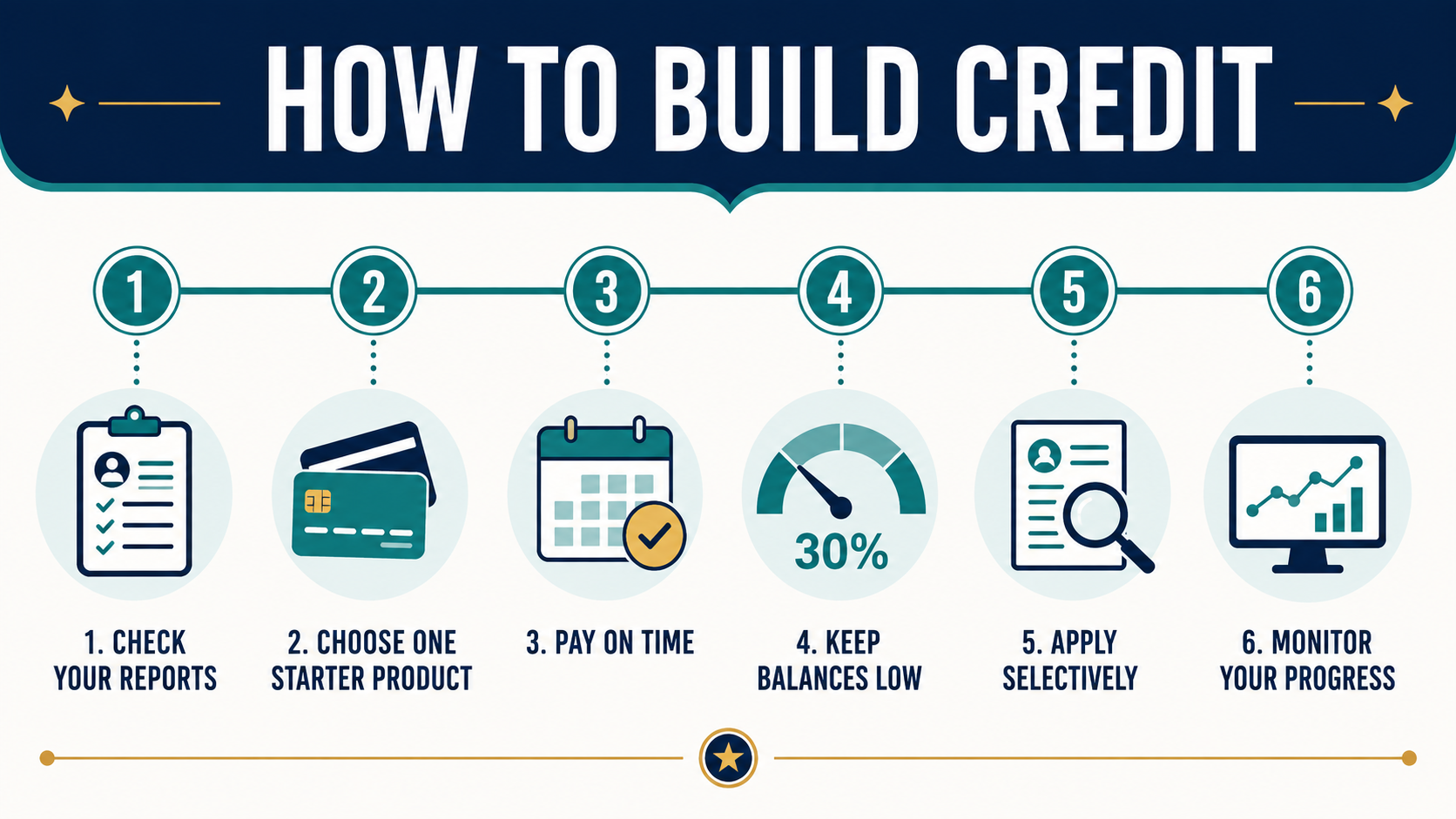
How to Build Credit in Six Steps
1Check Your Credit Reports First
You may already have a credit file through a student loan, authorized-user account, or another reported obligation. Request reports from Equifax, Experian, and TransUnion at AnnualCreditReport.com. Checking your own report is a soft inquiry and does not lower your score.
Review names, addresses, accounts, balances, limits, and payment history. If information is inaccurate or incomplete, dispute it with both the credit bureau and the company that supplied it. Keep copies of documents and correspondence. Do not dispute accurate information simply because it is unfavorable.
2Choose One Affordable Starter Product
If you have no usable revolving account, compare secured cards from banks and credit unions. Look for reporting to all three nationwide bureaus, a manageable deposit, no or low annual fee, transparent graduation terms, and an APR you understand—even if you plan to pay in full.
A credit-builder loan can add installment history while building savings, but it is still a financial obligation. Compare the total dollar cost, payment amount, reporting policy, early-payoff rules, and release schedule. Choose a payment you can comfortably afford through an income disruption.
3Pay Every Account on Time
Payment history is a leading factor in widely used scoring models. Set automatic payment for at least the minimum as a backup, then add calendar and account alerts. Confirm each payment actually posted; a failed bank transfer can still create a late payment.
If you expect difficulty, contact the creditor before the due date and ask about hardship options. Get any arrangement in writing and ask how it will be reported. Never ignore a bill because the account is rarely used.
4Keep Credit Card Balances Manageable
Credit utilization is the reported revolving balance divided by the limit. A $100 balance on a $500 limit is 20% utilization. Models may consider utilization on each card and across all cards.
The Consumer Financial Protection Bureau notes that experts often advise staying below 30%, while some suggest lower. This is a guideline, not a magic cliff or guaranteed target. Lower reported balances generally signal less reliance on available credit. Paying the statement balance in full by the due date can avoid interest when a grace period applies—you do not need to carry debt to build credit.
5Apply Selectively and Keep Useful History
Each formal application may create a hard inquiry, and several new accounts can make a thin file look riskier. Compare eligibility, costs, and terms before applying. Prequalification may use a soft check, but confirm the issuer’s disclosure.
Account age also matters. Keep an established no-fee card open when it remains secure and manageable, but do not retain a costly product or one that encourages overspending solely for a score. Financial safety comes first.
6Monitor Progress Without Chasing Every Point
Creditors typically report on their own schedules, so balances and payments may not appear immediately. Track the same score model over time rather than comparing unrelated scores from different apps. Small movements are normal.
For a standard FICO Score, FICO says a report generally needs at least one account opened for six months or more and at least one account reported within the past six months. Other models have different requirements. That eligibility rule is not a promise that a score will be high after six months.
What Usually Does Not Build Credit?
A product helps only if useful payment information reaches a credit bureau and is considered by a scoring model. The CFPB notes that ordinary debit-card and cash purchases do not build a borrowing record. Prepaid cards generally do not either. Payday lenders often do not report positive payments, and some “buy here, pay here” dealers may report only negative information unless they promise otherwise in writing.
A Simple First-Year Credit Plan
| Period | Primary action | What to watch |
|---|---|---|
| Before opening | Review reports, set a budget, compare one suitable product. | Fees, APR, bureau reporting, deposit or loan terms. |
| Months 1–3 | Make a small planned purchase and pay on time. | Autopay success, statement balance, fraud alerts. |
| Months 4–6 | Continue the same routine; avoid unnecessary applications. | Reported limits, balances, and payment accuracy. |
| Months 7–12 | Review reports again and evaluate whether the product still fits. | Progress across the same model, fees, upgrade eligibility. |
This timeline is a behavior plan, not a score forecast. A thin file, missed payment, high reported balance, or unreported account can change the outcome. Consistency matters more than speed.
Common Credit-Building Mistakes
- Opening multiple accounts before learning to manage one.
- Carrying a balance and paying interest because of the myth that debt builds credit faster.
- Using most of a low credit limit and waiting until after the statement closes to pay.
- Missing a due date because autopay was connected to an underfunded account.
- Choosing a product without confirming which bureaus receive payment data.
- Co-signing or becoming jointly responsible without understanding the full obligation.
- Paying a company that promises a guaranteed score increase or removal of accurate negative information.
How Long Does It Take to Build Credit?
There is no universal timeline. Generating a FICO Score may require roughly six months of qualifying reported history, while meaningful improvement or recovery can take longer. The result depends on the starting file, reporting frequency, balances, payments, new applications, and the scoring model.
Avoid judging progress week by week. Review reports for accuracy, keep the system affordable, and let positive history accumulate. No legitimate lender, bureau, or credit-repair company can guarantee a specific number by a certain date.
Frequently Asked Questions
What is the fastest safe way to build credit?
There is no guaranteed shortcut. A practical approach is one low-cost account that reports to the bureaus, small affordable use, and every payment on time. Avoid opening several accounts at once.
Can I build credit without a credit card?
Yes. A credit-builder loan or an existing reported installment loan may establish history. Some rent-reporting services may help certain files, but confirm bureau coverage, fees, and model eligibility.
How much should I spend on a secured credit card?
Only charge what your budget can repay. Keeping the reported balance low relative to the limit may help, but no utilization percentage guarantees a score. Paying interest is unnecessary.
Does being an authorized user build credit?
It can if the issuer reports the account to your credit files and the account is well managed. The primary user’s high balances or late payments may also affect what is reported, so verify the arrangement.
Do debit-card purchases build credit?
Ordinary debit purchases generally do not because they use money from a deposit account rather than creating a reported borrowing and repayment history.
Bottom Line
The best answer to how to build credit is deliberately unexciting: check your reports, choose one affordable reporting product, pay on time, keep revolving balances low, apply sparingly, and monitor for errors. Build a system that remains sustainable even when life is busy—because a long, accurate record of responsible use is more valuable than a short-lived scoring trick.
Disclaimer: This article provides general educational information, not financial, legal, tax, lending, or credit-repair advice. Product terms, reporting practices, scoring results, and lender decisions vary.
Sources
- Consumer Financial Protection Bureau: Ways to start or rebuild a good credit history
- Consumer Financial Protection Bureau: How to get and keep a good credit score
- Consumer Financial Protection Bureau: How to rebuild your credit
- myFICO: Building a credit history
- Federal Trade Commission: Fair Credit Reporting Act