Online Banks for Small Balances
A low balance should not force you into a high-cost bank account. The right online account can help you avoid monthly charges, monitor every dollar, and keep everyday banking simple.
Online banks for small balances can be a practical option when you do not keep much money in checking or savings. Their lower overhead may support accounts with no monthly maintenance fee, no opening minimum, useful balance alerts, and broad ATM access. But “online” does not automatically mean inexpensive, and “free checking” does not mean every possible service is free.

For a small balance, predictable costs and strong account controls usually matter more than flashy extras.
- Prioritize a true $0 monthly maintenance fee and no ongoing minimum balance requirement.
- Check overdraft, nonsufficient funds, out-of-network ATM, cash deposit, and expedited transfer fees.
- Turn on low-balance and transaction alerts immediately.
- Confirm deposit insurance through the FDIC’s official tools before opening an account.
- Read the account disclosure; promotional language is not a substitute for the fee schedule.
Why a Small Balance Changes the Banking Math
Fixed fees hit smaller balances harder. An illustrative $10 monthly charge would equal 10% of a $100 balance in a single month. Even one out-of-network ATM fee can erase the interest a modest savings balance earns for a long time. That is why the best account for a large depositor may not be the best low balance checking account.
With limited cash, your first job is often to preserve principal and maintain access. A high annual percentage yield can help, but avoiding a recurring fee is usually more valuable. Compare the account’s full cost before comparing its rate.
What to Compare Before Opening an Account
| Feature | Small-balance-friendly standard | What to verify |
|---|---|---|
| Monthly maintenance | $0 without conditions | Whether direct deposit or a minimum balance is required |
| Minimums | No opening or ongoing minimum | Opening deposit, daily balance, and average balance rules |
| Overdraft | Decline, grace period, or low-cost option | Overdraft and nonsufficient-funds fees; opt-in settings |
| ATM access | Large fee-free network | Operator fees, bank fees, and reimbursement limits |
| Alerts | Custom low-balance and transaction alerts | Push, text, email, thresholds, and real-time timing |
| Cash deposits | Available at a reasonable total cost | Supported locations, retailer charges, and posting time |
| Deposit insurance | FDIC-insured bank | Bank identity and insurance status in BankFind |
Seven Features That Matter Most
7. Clear disclosures and support
Federal Truth in Savings rules require institutions to disclose key terms and fees. Still, disclosures can be dense. Search the document for “monthly,” “minimum,” “overdraft,” “ATM,” “transfer,” and “inactivity.” Test the support channel before moving all your money: look for phone hours, secure chat, dispute procedures, and card-replacement options.
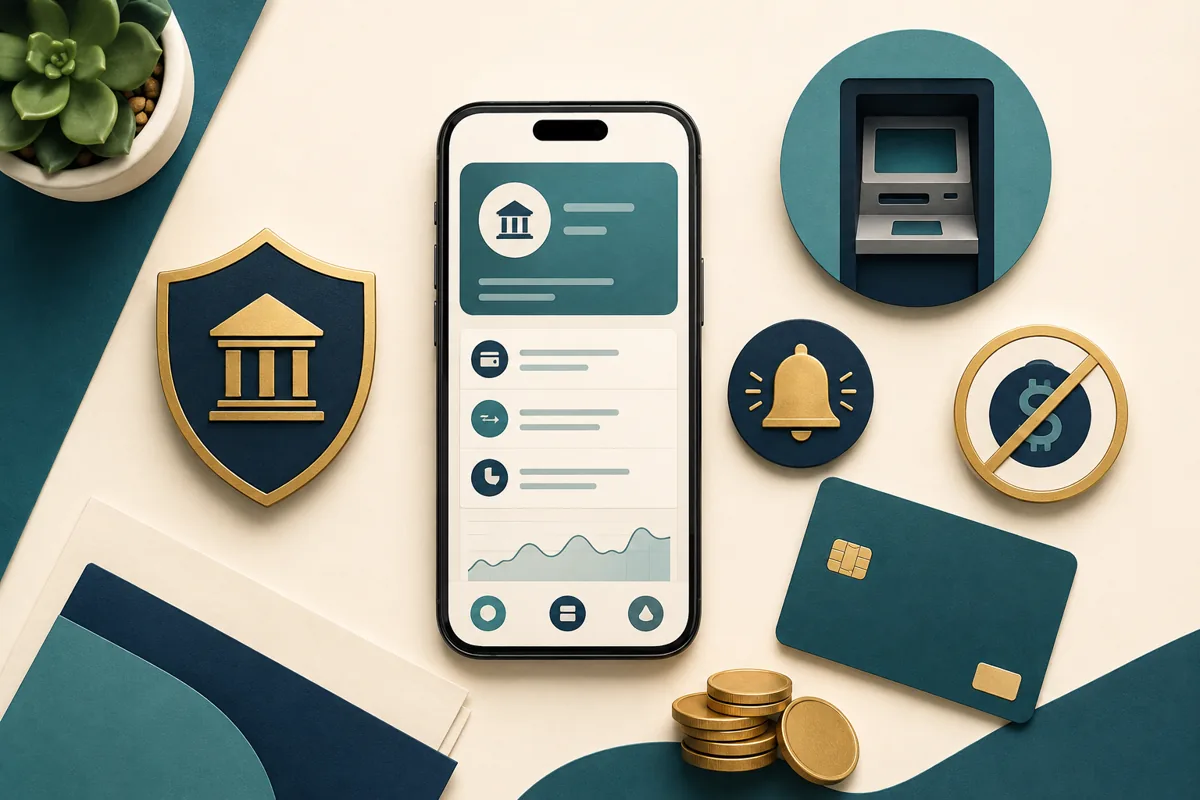
Use a whole-account checklist: one avoidable fee can matter more than a small difference in APY.
No Minimum Balance Does Not Always Mean No Fees
A no minimum balance bank account may let your balance fall to zero without a maintenance charge, yet still charge for out-of-network ATMs, wire transfers, paper checks, stop payments, returned deposits, or expedited services. The CFPB explains that an account advertised as “free” or “no cost” cannot carry a monthly service or minimum-balance fee, but it may still have specific transaction fees.
Also distinguish an opening minimum from an ongoing minimum. An account might require $25 to open but impose no continuing threshold. Another might open with $0 but waive its monthly fee only when you receive qualifying direct deposits. If your income is irregular, a conditional waiver creates uncertainty.
How to Manage Overdraft Risk
Overdraft policies deserve special attention when your balance runs close to zero. Debit-card overdraft coverage may let a purchase go through and then charge a fee; declining that coverage may cause the purchase to be rejected instead. Checks and recurring electronic payments can follow different rules, so read the bank’s terms.
- Choose the lowest-risk overdraft setting available.
- Set a low-balance alert above your largest routine bill.
- Keep a small buffer if possible, even if it grows slowly.
- Review scheduled subscriptions and autopay dates weekly.
- Link savings only after checking transfer limits and fees.
The FDIC recommends monitoring balances and using alerts to reduce surprises. Some certified Bank On accounts are designed without overdraft or nonsufficient-funds fees, which may be worth investigating through the official Bank On directory and the institution’s current disclosures.
Deposit Insurance: Verify the Bank, Not Just the App
An attractive app is not proof that deposits are insured. Confirm that the institution is an FDIC-insured bank and understand which bank actually holds the funds. The FDIC states that deposits at an insured bank are automatically covered to at least $250,000 per depositor, per insured bank, for each account ownership category. Most small balances are far below that limit, but verification still matters.
Use the FDIC’s BankFind Suite, match the legal bank name, and review how a financial technology company describes its partner-bank arrangement. Deposit insurance protects covered deposits if an insured bank fails; it does not protect investments, cryptocurrency, or losses caused by scams.
A Simple Setup Plan
- Estimate your normal low point. Review two or three months of bills and deposits.
- Shortlist accounts. Exclude any with unavoidable monthly fees or unrealistic waiver conditions.
- Compare total access costs. Include ATMs, cash deposits, transfers, checks, and customer support.
- Verify insurance. Use the official FDIC database, not only marketing copy.
- Open with a manageable amount. Keep the old account active until deposits and payments work correctly.
- Turn on alerts. Add low-balance, debit purchase, withdrawal, and deposit notifications.
- Move payments carefully. Track every autopay to avoid missed bills or duplicate withdrawals.
Common Mistakes to Avoid
- Chasing APY while ignoring fees. A monthly charge can overwhelm interest on a small balance.
- Assuming every ATM is free. Both the ATM operator and your bank may charge.
- Relying on a direct-deposit waiver. Freelance, seasonal, or benefit income may not meet the bank’s definition.
- Keeping all funds in one spending account. A separate savings pocket can reduce accidental spending, if transfers remain accessible.
- Switching too quickly. Pending checks, subscriptions, and delayed deposits can create avoidable problems.
Frequently Asked Questions
Are online banks good for small balances?
They can be, especially when the account has no monthly maintenance fee, no ongoing minimum, useful alerts, and convenient free ATM access. Compare the full fee schedule rather than assuming every online bank is low cost.
Can I open an online bank account with $0?
Some institutions allow a $0 opening balance, while others require a small initial deposit. Confirm both the opening requirement and any balance needed later to avoid fees.
What fee matters most with a low balance?
Recurring monthly maintenance fees usually deserve the first look because they are predictable and repeat automatically. Overdraft and ATM fees can also be significant, depending on how you use the account.
Is a no-fee account completely free?
Not necessarily. A free checking account cannot have monthly service or minimum-balance fees, according to the CFPB, but it may charge for services such as out-of-network ATMs, overdrafts, stop payments, wires, or paper checks.
How can I tell whether an online bank is FDIC insured?
Search the institution’s legal name in the FDIC BankFind Suite. If you are using a financial technology app, identify the partner bank that holds the deposit and read the account agreement.
Bottom Line
The best online banks for small balances make costs predictable. Start with no monthly fee, no continuing minimum, safer overdraft choices, accessible ATMs, customizable alerts, and verified deposit insurance. Once those basics are covered, compare APY and extras.